
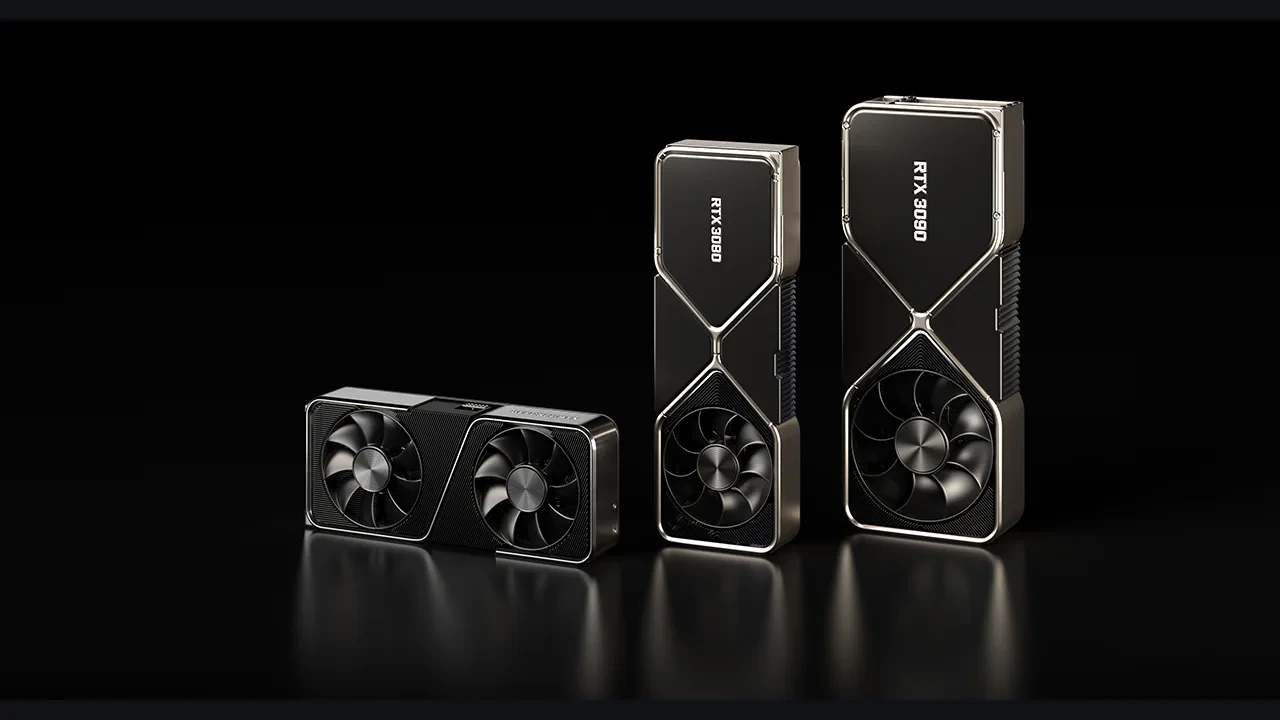
GeForce RTX 3060 DLSS 5 compatibility: what the desktop card actually supports
NVIDIA has not announced official DLSS 5 support for the desktop GeForce RTX 3060. The card’s current shipping upscaling and reconstruction package is DLSS 4.5, including Super Resolution and Ray Reconstruction.
The RTX 3060 has a large installed base, so studios will understandably test every new NVIDIA reconstruction release on it. Still, nothing beyond DLSS 4.5 belongs in a specification until NVIDIA publishes an SDK release note or supported-hardware list that names the SKU.
This is a current-support question, not a prediction about future products. Developers and players need to work from the card’s shipping feature set and keep any DLSS 5 plans conditional.
Where the desktop RTX 3060 sits in NVIDIA’s range
NVIDIA launched the desktop GeForce RTX 3060 in early 2021 as an entry-level Ampere card for 1080p gaming and mainstream creator workloads. The reference design uses the GA106 die, 12 GB of GDDR6 on a 192-bit bus, and 3,584 CUDA cores. It also includes the second-generation RT cores and third-generation Tensor Cores introduced with Ampere. That unusually large 12 GB frame buffer has kept the card useful in QA labs, indie hardware pools, and certification benches into the RTX 50 series generation.
For game teams, its availability matters as much as its specification. The RTX 3060 appears throughout hardware surveys, certification labs, and player telemetry. A DLSS configuration that excludes it also cuts out a sizeable part of the 1080p audience. If a retail PC build lists the card as its minimum specification, keep it as a permanent row in the test matrix.
What DLSS 5 currently means for developers
The version number matters less than the target Tensor Core generation, SDK or plugin interface, and official hardware matrix. NVIDIA’s research page places DLSS 5 in a pre-shippable research phase for most production work. It does not promise desktop RTX 3060 support, and NVIDIA has not announced the card for launch.
A lab page or research paper is not a shipping driver, SDK, or in-game toggle. Older hardware might receive the whole feature later, receive only part of it, or never be added. Until NVIDIA issues an explicit hardware list, calling DLSS 5 “supported on RTX 3060” is unsafe in a production plan, marketing copy, or store description.
NVIDIA has previously previewed neural reconstruction research months before releasing a related, narrower SDK feature. The retail feature may keep the research name or ship under a different version. A studio that treats the research page as a binding specification risks having to retract its claim if NVIDIA narrows or renames the release.
How earlier DLSS features mapped to GPU generations
Major DLSS capability changes have often followed new Tensor Core generations, with selective backward support. DLSS 2 reached the original RTX 20 series, whose second-generation Tensor Cores share the basic INT8 and FP16 paths used by Ampere. DLSS 3 introduced Frame Generation and required newer hardware. NVIDIA’s official list covered RTX 40 desktop and laptop GPUs, while RTX 20 and RTX 30 cards retained their existing upscaling paths without gaining Frame Generation.
DLSS 3.5 Ray Reconstruction worked on RTX 20 and newer hardware because those GPUs already had the needed ray-tracing and Tensor paths. DLSS 4 Multi Frame Generation initially centered on RTX 50 hardware. DLSS 4.5 continues to bundle broadly deployable Super Resolution and Ray Reconstruction updates while keeping stricter hardware limits around Frame Generation. That split has defined the RTX 3060 for several driver cycles: model-only reconstruction improvements arrive, but new frame-generation classes remain unavailable.
DLSS 5 could follow the wider Ray Reconstruction pattern or the newer-hardware Multi Frame Generation pattern. Only NVIDIA’s published support list can settle that question for the desktop RTX 3060.
DLSS 4.5 on the desktop RTX 3060
The card’s current shipping feature set combines Super Resolution with Ray Reconstruction. Super Resolution renders at a lower internal resolution, then uses motion vectors, depth, and a trained neural network to reconstruct the higher-resolution output. Ray Reconstruction replaces parts of a traditional hand-written denoising chain for ray-traced effects with a single network trained across more lighting conditions than a hand-tuned denoiser can encode. Both paths run on Ampere’s third-generation Tensor Cores.
A DLSS 4.5 build can expose the following on a desktop RTX 3060:
- Super Resolution modes including Quality, Balanced, Performance, and Ultra Performance in games whose DLSS integration lists the card.
- Ray Reconstruction in titles that implement it, usually alongside an NRD or hand-written denoiser and a switch to the neural alternative.
- Frame Generation only on later hardware. DLSS 4.5 integrations do not normally enable it on Ampere cards.
- Multi Frame Generation only on supported newer hardware. Its RTX 50 series form is unavailable on Ampere.
The RTX 3060 sits below the RTX 3060 Ti, RTX 3070, RTX 3070 Ti, RTX 3080, RTX 3080 Ti, RTX 3090, and RTX 3090 Ti in the desktop family. The GeForce 30 series Wikipedia article lists those specifications and explains Ampere’s SM and memory changes from Turing. That background matters because NVIDIA normally gates DLSS features by Tensor Core generation and required execution path, not by driver number alone.
Teams already have working reference code for Super Resolution and Ray Reconstruction on this tier. Ignoring that integration while waiting for DLSS 5 would leave performance unused in shipping builds today.
Reading the public DLSS 5 signals
Information usually arrives in order: research material, driver and SDK documentation, game integration announcements, then store-page claims. Those stages do not carry equal weight.
Research pages describe what a model and training pipeline can do. Near release, driver and SDK documents name supported GPUs, minimum driver versions, and the features available on each card. Studios announce game integrations later and often mirror that list, sometimes excluding hardware they have not finished testing.
The safe reading today is narrow. DLSS 5 exists as a research program, and NVIDIA has not confirmed the RTX 3060 for it. A supported-hardware list, SDK release note, or major driver changelog naming the card would change that status. Until then, a positive compatibility claim is marketing speculation rather than documentation.
Keep a short internal decision log. Record whether a producer or marketing lead relied on the research page, then update that entry when the SDK publishes its actual support list. This small bit of bookkeeping makes it much easier to reverse an early assumption if the shipping feature proves narrower than the preview.
Planning a game for the RTX 3060 audience
A studio serving a 1080p-heavy audience should make DLSS 4.5 the shipping baseline and keep the renderer modular enough to accept a later DLSS 5 SDK or plugin without redesign. The following work is useful now, regardless of future support.
- Integrate the current Super Resolution SDK and verify Quality, Balanced, Performance, and Ultra Performance modes on actual RTX 3060 silicon, not only RTX 40 or RTX 50 developer systems.
- Offer Ray Reconstruction for ray-traced effects and document its visual and performance differences so QA can catch regressions during patches.
- Keep upscaling and frame-generation controls in separate, clearly named CVars or settings, allowing the engine to gate a future feature by GPU.
- Track the official hardware list in driver and SDK release notes, then hide or disable a new feature unless the runtime confirms support.
- Run a fixed benchmark scene on at least one RTX 3060 for every certified driver branch, since Ampere behavior can change even when the headline feature does not.
- Add a build-time check that compares marketing copy and in-game labels with the same support list, preventing a late SDK change from leaving the store page out of date.
None of this requires confirmed DLSS 5 support. It prepares the integration for a future plugin while improving the stability of the DLSS 4.5 build players can use now.
What RTX 3060 owners can safely assume
The card can run Super Resolution wherever a current SDK integration includes it. Ray Reconstruction works when the developer has implemented and enabled that path. Frame Generation features remain unavailable, and a correctly gated settings menu should not show those toggles on this GPU.
Treat third-party tools, mods, and wrappers claiming to enable DLSS 5 with caution. The number refers to a specific model and SDK release. Inserting an unsigned or unsupported model is not equivalent to turning on a normal game option. An unofficial wrapper can cause unstable frames, interfere with anti-cheat, or void the GPU warranty if it alters power management. If NVIDIA adds official support, it will arrive through a driver and SDK update.
DLSS covers NVIDIA’s neural upscaling, frame-generation, and ray-reconstruction features. Public releases progressed from the early DLSS 1.0 convolutional models to DLSS 2.x temporal upscaling, DLSS 3 Frame Generation, and DLSS 3.5 Ray Reconstruction. DLSS 4 and 4.5 added Multi Frame Generation variants and updated transformer-based reconstruction networks. NVIDIA describes the next model generation on its DLSS 5 research page before it becomes a shipping feature.
For a specific game and operating system, check the Game Ready Driver notes for the SKU, the DLSS SDK version in the build, and the studio’s patch notes. Those sources together describe what is actually live. Reading them before a forum report prevents a great deal of confusion around driver-specific conditions.
Desktop RTX 3060 feature reference
This table summarizes the public state for common DLSS options on the desktop card. A game’s own SDK version and minimum specification can still narrow the list.
| Feature | Current shipping version | Status on desktop GeForce RTX 3060 | Notes for QA |
|---|---|---|---|
| DLSS Super Resolution | DLSS 4.5 | Supported where the integrated game lists the card | Verify Quality, Balanced, Performance, and Ultra Performance modes independently |
| DLSS Ray Reconstruction | DLSS 4.5 | Supported where the integrated game lists the card | Compare against the hand-written denoiser on a known ray-traced scene |
| DLSS Frame Generation | DLSS 3 and later branches | Not supported on RTX 30 series | Menu toggle should be hidden or disabled on this SKU |
| DLSS Multi Frame Generation | DLSS 4 / 4.5 | Not supported on RTX 30 series | Same as above; do not surface the toggle |
| DLSS 5 | Not yet officially launched for this card | No official launch support has been announced | Re-evaluate after an official supported-hardware list is published |
This is a working summary rather than a promise for every title. Teams that need one source of truth should copy the table into the project documentation and put the exact SDK version in the header.
DLSS 4.5 compared with a hypothetical DLSS 5 build
The DLSS 5 column below is a planning sketch, not a benchmark or a claim that the feature runs on an RTX 3060. It uses the historical rollout pattern to show which project assumptions still need confirmation.
| Attribute | DLSS 4.5 (current on RTX 3060) | DLSS 5 (hypothetical for RTX 3060) |
|---|---|---|
| Super Resolution modes | Quality, Balanced, Performance, Ultra Performance | Likely similar mode set, model retrained |
| Reconstruction model | Updated transformer-based ray reconstruction network | Successor model from the DLSS 5 research line, with broader training data |
| Frame Generation | Not available on RTX 30 series | Unconfirmed; support depends on Tensor core path used |
| Multi Frame Generation | Not available on RTX 30 series | Unconfirmed; more likely gated to newer hardware |
| VRAM pressure on a 12 GB card | Modest; mostly a function of base resolution and motion-vector buffers | Depends on model size; could add a small overhead |
| Driver requirement | Current Game Ready or Studio Driver branch | A future driver branch tied to the official SDK |
| Official position on RTX 3060 | Listed in supported-hardware documentation for Super Resolution and Ray Reconstruction | No official launch support has been announced |
Use the comparison to decide which DLSS features are mandatory for the minimum specification and which are optional on faster hardware. Settling that before marketing approval costs far less than rewriting a store page or handling support complaints after release.
Failure modes caused by assuming support
- A store page advertises DLSS 5 although the listed minimum GPU cannot enable it. Tie feature claims to the studio’s tested-hardware list.
- The settings menu shows Frame Generation or Multi Frame Generation on RTX 30 hardware because every DLSS option uses one broad flag. Gate each feature by GPU family and minimum driver.
- QA tests only RTX 40 and RTX 50 systems, missing an Ampere-specific visual or stability regression. Keep an RTX 3060 in every driver certification pass.
- A research result is treated as a shipping feature. Define release support by the available driver and SDK, not the existence of a lab page.
- A driver fixes newer hardware but breaks Super Resolution on Ampere. Replay the same benchmark scene across driver branches.
- Patch notes repeat NVIDIA press language without confirming that the build contains the named model. Require the SDK version, driver branch, and internal certification result before publishing.
These are ordinary multi-generation PC support problems. A little plumbing before launch is cheaper than diagnosing them from player reports.
Keeping the RTX 3060 in the test matrix
Maintain a small compatibility table with the GPU, shipping SDK, current Game Ready Driver, exposed features, and last verification date. It answers most producer, certification, and customer-support questions without another search through release notes.
The RTX 3060 row currently lists Super Resolution and Ray Reconstruction under DLSS 4.5 when the game includes the card. Frame Generation classes are outside Ampere support, and DLSS 5 is not on the launch list. Recheck those entries when NVIDIA publishes a new driver or SDK rather than assuming the old status still holds.
Long-running PC games already use this discipline for DirectX feature levels, Vulkan extensions, and console graphics APIs. DLSS is another column. Assigning the row to a named engineer usually works better than assigning it vaguely to the graphics team; someone then owns the update on SDK release day.
How to brief a producer
A short producer brief should state that NVIDIA has not announced desktop RTX 3060 support for DLSS 5. It should name the supported DLSS 4.5 features, list unsupported family features such as Frame Generation, and explain that NVIDIA could change the answer through a published hardware list. That is enough detail for a marketing review without turning a research preview into a promise.
Name the person responsible for rechecking the matrix when the next branch ships. Otherwise, an accurate brief has a habit of surviving long after the facts change.
Frequently asked questions
Is DLSS 5 officially supported on the desktop GeForce RTX 3060?
No official launch support has been announced. DLSS 4.5 Super Resolution and Ray Reconstruction remain the card’s current NVIDIA upscaling and reconstruction package. Confirmation would require an NVIDIA hardware list, SDK release note, or Game Ready Driver changelog that names the SKU.
What DLSS features can a desktop GeForce RTX 3060 use today?
It can run Super Resolution and Ray Reconstruction when the game uses a current SDK and includes the card. Frame Generation and Multi Frame Generation from the wider DLSS 3, 4, and 4.5 families are not in the RTX 30 support set.
Could DLSS 5 be added to the RTX 3060 in a later driver update?
It is possible in principle. NVIDIA has extended conservative model updates such as Ray Reconstruction to older generations before. Current production plans should still treat support as unconfirmed until a published list names the RTX 3060.
What is the difference between DLSS 4.5 and DLSS 5?
DLSS 4.5 is a shipping branch with Super Resolution, Ray Reconstruction, and Frame Generation family features, while Multi Frame Generation usually targets RTX 50 cards. NVIDIA’s research page describes DLSS 5 as the next upscaling and reconstruction model line. Its final feature split, Tensor Core requirements, and hardware list are not publicly fixed.
Will Frame Generation ever come to the RTX 3060?
NVIDIA has made no public commitment. The DLSS 3 and DLSS 4 / 4.5 feature relies on optical-flow and Tensor paths in newer GPUs. It would need an official Ampere path in the SDK before developers could support it.
How should a game studio test DLSS on the RTX 3060 today?
Keep an RTX 3060 on the certification bench and use a fixed scene with a demanding ray-traced effect, a fast camera move, and a slow pan. Replay it on every certified Game Ready Driver branch. The project matrix should list Super Resolution and Ray Reconstruction for the card, and the menu should suppress Frame Generation.
Why does the RTX 3060 still get new DLSS driver support if it does not get DLSS 5?
Drivers deliver updates for the entire supported feature set. They can improve Super Resolution and Ray Reconstruction, fix reconstruction artifacts, or repair Ampere compatibility without adding DLSS 5. The RTX 3060 remains supported for the features already available to it.
Is the laptop RTX 3060 in the same situation as the desktop card?
This compatibility statement covers the desktop GPU only. Laptop and Max-Q variants have separate power, thermal, and support profiles. Check the laptop SKU against its own hardware list before making the same claim.
Where can I find the official supported-hardware list for DLSS 5 when it is published?
Check the NVIDIA DLSS SDK developer documentation, matching Game Ready Driver release notes, and the official DLSS product page. The research page explains the model but does not replace shipping SDK or driver support documentation.
Should a small studio with a 1080p-focused audience treat the RTX 3060 as a minimum spec card for DLSS?
Yes. It is common in 1080p systems, and DLSS 4.5 Super Resolution plus Ray Reconstruction makes a practical baseline. List the card in the minimum specification, disable Frame Generation on RTX 30 hardware, and keep the integration ready for a later DLSS 5 SDK only if its support matrix includes the card.
Leave a Reply