
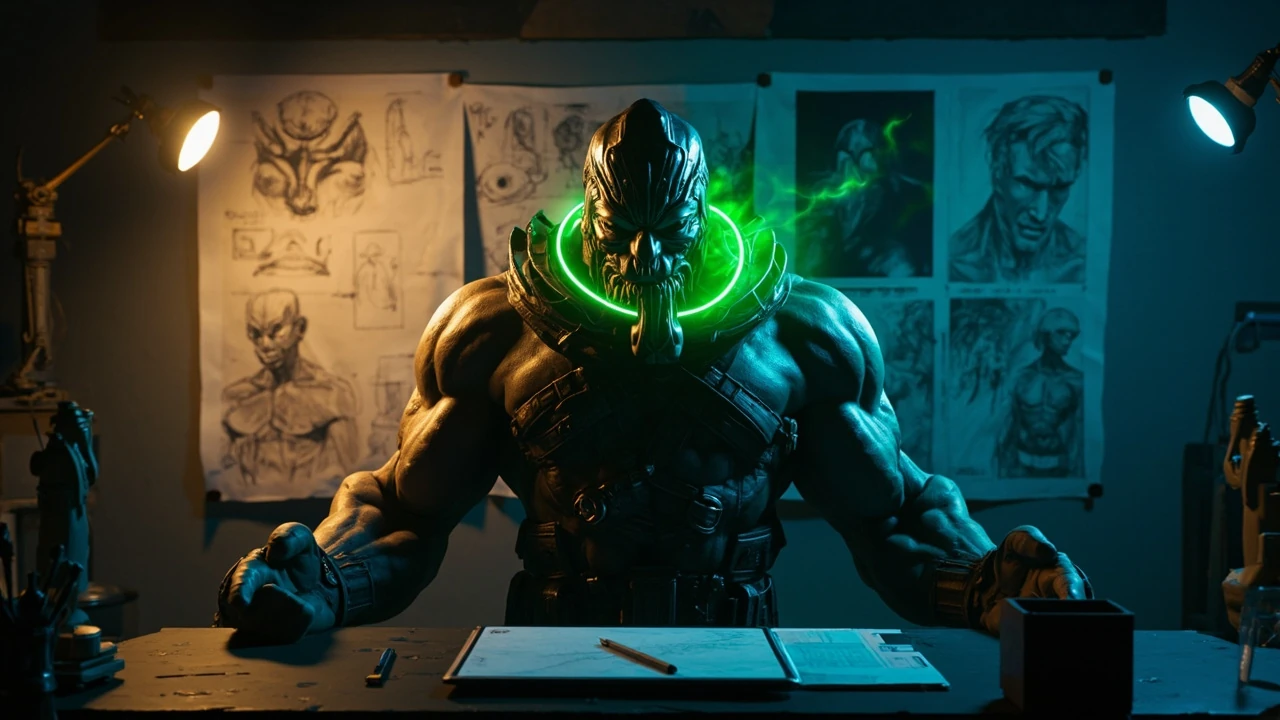
Absolute Batman Bane: a developer’s brief on the new villain design
For a character that has appeared in comics, animated series, films, and at least one well-known open-world action game, Bane tends to arrive in a new medium as a fixed bundle of expectations: a massive frame, a breathing mask, a network of tubes, and a steroid analogue that mechanically enforces a two-phase encounter. The Absolute imprint’s redesign of Bane, as the new wave of absolute batman bane coverage makes clear, does not simply re-costume the same archetype. It rewrites the character’s origin and, more importantly for game teams, the visual and mechanical vocabulary that any adaptation would need to absorb. This brief is written for developers, technical artists, and encounter designers who want to know what actually changes when Bane is reconceived as a younger, leaner, ideological antagonist, and what stays useful from the legacy design.
The reader’s working assumption here is that the Absolute line is a published comic imprint, and that the re-imagined Bane is the version any future licensed game would have to model. The questions worth answering are concrete: how does the new silhouette read on a 3D rig, where does the Venom apparatus belong in the model hierarchy, what does the rewritten origin do to motivation, and which elements of the old Bane remain useful as gameplay or boss-fight shorthand. The notes below are organized so that a combat designer, a character art lead, and a narrative director can each pull the sections that match their work.
What the Absolute imprint actually changes about Bane
Absolute Batman relocates Bruce Wayne to a working-class background with fewer inherited resources and a different support network. Bane participates in that same continuity reset. The redesign drops the long-standing “man behind the mask” Cold War exile framing and replaces it with a younger, politically charged antagonist whose physical augmentation is presented in a way that ties directly to the comic’s resource and class themes. The visual identity moves toward a tactical, almost paramilitary silhouette, with a slimmer mask that reads as functional rather than ceremonial, and a Venom-delivery system that looks closer to an improvised chemical harness than a piece of Cold War surplus hardware.
For development, the headline shift is that Bane no longer needs a full luchador mask and a chest-mounted tank to be legible as the character. That single change has cascading effects on rigging, cloth simulation, and first-read silhouette design. A character who no longer needs a heavy ceremonial mask can be shot from more angles, framed at closer distances, and still read as a serious physical threat because the proportions and posture carry the menace rather than the costume. The redesign also repositions the supporting cast of the comic so that Bane’s rise is tied to a more local power structure than a global one, which gives narrative designers a more contained set of locations to build around in a licensed title.
Why the redesign matters for character art and rigging
Legacy Bane imposes several costs on a real-time character pipeline. The mask covers a large share of facial real estate, which means reduced face-capture utility, more bone-driven facial animation work, and a heavier reliance on body and posture acting. The chest apparatus and the tubes over the shoulders add continuous cloth, collision, and self-shadowing work. The original silhouette is wide at the shoulders and chest, which complicates camera framing in third-person titles and forces animation teams to manage a more extreme body proportion range.
The redesigned absolute batman bane retains the imposing frame but tightens the silhouette. The harness sits closer to the body, the tubes are shorter and more contained, and the mask covers less of the face. Three practical effects follow:
- Facial capture becomes viable, which lowers mocap cleanup cost and makes performance-driven cutscenes easier to schedule.
- Cloth and collision budgets drop because the apparatus has fewer long, sweeping parts that swing during locomotion.
- Silhouette readability at long camera distances improves, which is a real benefit for a boss that the player needs to recognize in an arena or a wide exterior set.
None of this is a free pass. The tighter silhouette also means the model has to do more work with subtle proportions, because there is less surface area for the player to read character from. A technical artist who is handed a slimmer Bane brief has to think harder about neck-to-shoulder width, posture, and the way the harness sits across the trapezius line. The mask, because it covers less of the face, has to be modelled with more attention to eye-line and brow behavior, since the player’s eye will land there first during dialogue scenes. A small drift in the brow ridge or in the eye spacing can change the character from menacing to confused, which is the kind of detail that does not show up in a turnaround review but does show up in player reaction videos.
Rigging also benefits from the redesign in ways that are not immediately obvious. The legacy mask geometry forced rigs to either drive a heavy facial mesh through blend shapes or to push performance entirely onto the body. The redesigned mask has fewer occluding surfaces around the eyes, so a smaller set of corrective blend shapes can carry the same emotional range. That reduces the facial rig surface area, which shortens iteration time when a director asks for a different read on a specific line. It also makes the rig easier to port to a new body type if the project later decides to retarget Bane onto a player-sized rig for a flashback or a co-op sequence.
Combat design implications of a leaner Bane
Game designers who only know Bane from the two-phase “pump up after a cutscene” pattern have a narrow idea of what the character can do. The original design assumes that Venom turns a competent fighter into a superhuman one, and that the player should be allowed to interrupt or counter the injection to keep the encounter fair. That pattern still works, but the redesign changes the timing of it. A younger, less augmented Bane can plausibly be a fast technical fighter in his base state, with the chemical boost functioning as a finisher state rather than a recovery state. That is a meaningful difference for a team planning a difficulty curve, because a finisher state can be tuned to last longer than a recovery state without making the encounter feel cheap.
| Design element | Legacy Bane pattern | Absolute Bane pattern | Effect on encounter |
|---|---|---|---|
| Base move set | Slow, heavy, posture-based | Faster, technical, leverage-based | Opens up early-fight pacing |
| Venom trigger | Mid-fight power spike | Late-fight escalation | Shifts pressure curve later |
| Counter window | Interrupt the injection | Drain the harness or break the seal | New boss mechanic vocabulary |
| Stagger behavior | Brief stagger when unboosted | Longer stagger when harness is damaged | Rewards sustained pressure |
| Stance readability | Wide silhouette, slow transitions | Tighter silhouette, faster transitions | Tighter reaction windows for the player |
The practical takeaway is that a redesigned Bane is no longer a guaranteed “big slow guy who turns fast and strong.” He is a more flexible combat template, which means a lead encounter designer can put him in earlier and smaller encounters without overshooting the difficulty curve. A boss with a fast technical base kit and a clear late-fight escalation is also easier to tune on a per-platform basis, because the unboosted phase has more animation states to adjust. On a lower-end target, the team can drop a few of the faster combos and shorten the base phase, while keeping the escalation intact, and the player will still read the fight as a complete encounter rather than a stripped-down version.
Stagger and recovery design also changes. The legacy Bane staggers briefly when unboosted, which is a small window the player can exploit, but the window is short enough that many players only learn it on a second attempt. The redesigned Bane staggers for longer when the harness is damaged, which is a more legible condition because the visual cue is the glowing green seal flickering, not just a generic hit reaction. A player who learns to read the seal can plan the stagger window as a deliberate part of the fight rather than as a lucky break. That kind of readability is the difference between a boss that frustrates players and a boss that rewards pattern recognition.
Motivation and narrative framing for writers
The classic Bane is most often written as a strategist who breaks the hero’s body and his symbol. The redesigned Bane leans into ideology rather than personal vendetta. That changes the dialogue pass significantly. A Bane who argues from a political position needs writing that can hold up to repeated listen-throughs, because the player will hear the speech patterns in the second half of the fight. A Bane who only taunts gets one pass of dialogue polish and can be carried by vocal performance; an ideological Bane needs a writer who can write arguments that a player can engage with, ignore, or reject without breaking the scene.
Two production consequences follow. First, the audio team needs more variation in Bane’s line readings, because the player will hear the same arguments during a long boss fight and the lines will fatigue faster than a simpler “I am your reckoning” pattern. Second, the localization team needs more context. Ideological dialogue rarely translates cleanly, and a Bane who is defined by his rhetoric will require more localization review time than a Bane whose identity sits in his mask and his muscles. A third consequence, often overlooked, is that the cinematics team has to plan for more camera setups that frame Bane while he is talking, because the rhetoric is the point of the scene, and the camera has to give the rhetoric room to land.
How the redesign reads in third-person and first-person camera setups
Camera teams often take a hit when a major boss changes proportions. The legacy Bane, because of his width and his height, often forces the camera to pull back during combat, which reduces the impact of close-up reactions. A slimmer Bane sitting at a similar height can be framed more tightly without losing readability. That is good for impact frames during stagger and finish states, and it is good for the player’s spatial awareness because less of the screen is taken up by the boss’s body.
For a first-person title, the redesign is more nuanced. A first-person player does not see Bane’s body, only his mask, his harness, and his hands when they enter the camera frame. A slimmer mask with visible eyes becomes a much stronger focal point in first person, because the player’s gaze will land on the eye-line during close-quarters combat. A harness with fewer tubes gives the first-person animators less to animate when Bane grabs or grapples the player, which means cleaner hand-IK and fewer clipping problems. The redesign also gives first-person designers a cleaner excuse to break the player’s view with a face-to-face beat, because the mask now has the visual detail to carry that beat without resorting to a first-person camera shake.
Material and shader work for the new look
Material work is where many redesigns quietly succeed or fail. The original Bane’s tubes, tank, and mask are mostly rubber, leather, and brushed metal. The redesigned Bane’s harness looks closer to tactical nylon, exposed polymer, and injection-molded plastic. The shader work is simpler in some ways and harder in others. Treated fabric and nylon shaders are well understood and cheap to compute, but the harness has more small interacting parts, which means more draw calls and more material slots in the model.
| Material region | Legacy approach | Absolute approach | Shader complexity |
|---|---|---|---|
| Mask | Hard-surface polymer with painted detailing | Tactical polymer with fewer painted elements | Lower |
| Harness | Leather straps, metal buckles, rubber tubes | Nylon webbing, polymer clips, polymer tubes | Comparable, more small parts |
| Skin | Heavy, scarred, oil-slick sheen | Leaner, more visible vascularity | Higher for vein work |
| Tank | Prominent chest-mounted unit | Smaller integrated reservoir | Lower |
| Glow | Subtle pump-pulse | More active chemical glow | Higher for emissive layers |
The takeaway for a graphics programmer reviewing the budget is that the redesign trades the cost of large leather shaders and a big rubber mask for the cost of more small material instances and a more active emissive pass on the chemical apparatus. On modern engines that is usually a net win, but on a tight mobile or last-gen console budget it can swing the other way because of the higher part count. A technical director should run a representative test scene rather than trust the visual simplification, and should compare the frame timing against the legacy Bane under the same lighting setup before signing off on the cost model.
Audio design for a redesigned Bane
Audio for Bane has always carried a surprising amount of the character. The breathing apparatus, the heavy footfall, the deep voice, and the percussive sound design of the mask pump together form a recognizable audio signature. A redesigned Bane has a tighter mask and a smaller apparatus, which means the breathing sound is less filtered and the footfall is less amplified. The audio team has to decide whether to preserve the recognizable signature or to commit to the redesign and rebuild the audio identity.
The most defensible production choice is to keep the signature during escalation states and let the redesign breathe, literally, during the base state. A player who has been fighting a fast, technical Bane for two minutes will recognize the pump sound as a state change, and that recognition is the entire point of the audio design. The redesign gives the audio team a new opportunity: the chemical apparatus can have a longer, more articulated sound design across the fight, because there are more interaction points and more small parts to record. The audio team can also lean on the smaller reservoir as a more present sound source during the base phase, which keeps the apparatus audible without forcing the legacy filter.
Player expectation and brand continuity
Players have a strong mental model of Bane, and any redesign has to be evaluated against that model as well as against the comic. A redesigned Bane that drops too much of the recognizable silhouette will be received as a different character, not as a new version of the same character. The redesign has to thread a narrow needle: keep enough of the visual signature for the player to recognize Bane on the loading screen, while changing enough of the supporting elements to justify the new design. The mask, the harness, the muscle mass, and the chemical apparatus are the four anchors. A player needs to see at least three of those four to place the character.
For a licensed game, that brand continuity is also a contract question. The licensor will usually require that the character be recognizable to a casual reader of the comic, and the redesign is the licensor’s own statement about what recognizable means in 2026. The development team does not need to defend the redesign. They need to reproduce it faithfully enough to clear licensor review and to satisfy a player who has read the comic. That is a higher bar than reproducing a legacy design, because the licensor’s own creative team has set the reference, and any drift from that reference is easier for the licensor to call out.
Production planning: scope and scheduling for a redesigned Bane
Scope planning for a redesigned Bane is a useful exercise because it shows how a visual change translates into a schedule. The redesign is not free. The character art team has to rebuild the model and the textures, the rigging team has to rebuild the skeleton and the facial rig, the animation team has to re-block the move set to match the new proportions, the audio team has to re-record and re-mix the audio signature, the writing team has to rewrite the dialogue, the localization team has to retranslate, and the capture team has to redo any performance work that already exists.
- Character art and texture rebuild: depends on the engine’s existing Bane assets, but typically a medium-cost task because the topology has to change to match the new silhouette.
- Rig and face rebuild: usually the highest hidden cost, because facial rigs are rarely portable between very different mask shapes.
- Animation reblock: significant, because the move set has to be re-timed to match the new base state.
- Audio rebuild: medium, because the signature carries over even when the design changes.
- Dialogue rewrite: highly variable, depending on the new motivation, but rarely cheap because the lines have to land in the same beats.
A producer reviewing a schedule with a redesigned Bane on it should expect roughly a third more time on the character than they would have planned for a legacy Bane at the same fidelity. That is not because the redesign is more difficult in absolute terms, but because the team cannot reuse as much of the existing work as they would have with a simple re-skin. The schedule also has to include a licensor review window that lands before the rigging lock, because a late silhouette change is the most expensive kind of change order for a boss character.
Common implementation pitfalls to plan around
A few pitfalls are common enough across studios that they are worth naming directly. They are not specific to the redesign, but the redesign makes them more likely.
- Treating the redesign as a texture swap. The proportions and the apparatus placement have changed enough that a texture swap on a legacy rig will look wrong at the silhouette level.
- Reusing the legacy move set. A faster base state means the legacy move set will feel slow and leaden, and players will read the fight as sluggish rather than redesigned.
- Preserving the old audio signature unchanged. The pump sound, in particular, should change tone to match the new apparatus, or the audio will fight the visual.
- Underestimating the facial capture rework. A tighter mask does not eliminate face capture, it just changes which part of the face carries the performance.
- Skipping the localization pass. Ideological Bane needs more translation work, not less, and a late localization pass is the most common place for this to slip.
A sixth pitfall, less common but worth naming, is leaving the legacy Bane in the mocap library as a reference. Animators will reach for the strongest reference they have, and if the legacy clips are sitting in the library next to the new concept art, the move set will drift back toward the legacy timing under schedule pressure. The cleanest mitigation is to retire the legacy clips from the active library once the redesign is signed off, and to keep only the new reference in rotation.
How absolute batman bane fits into a broader encounter roster
Encounter rosters in action games tend to be tuned around archetypes. The classic Bane archetype is the slow heavy with a mid-fight escalation. A redesigned Bane can occupy a different archetype slot, namely the technical heavy with a late-fight escalation, and that slot is more flexible. It can be used in mid-game as a wall, in late game as a recurring threat, or in a story mode as a one-off set piece, without breaking the difficulty curve.
For a lead designer planning a roster, the redesigned Bane effectively replaces two archetype slots: the slow heavy and the political rhetorician. Combining those two roles in a single character reduces the total enemy count needed to cover both encounters, which is useful in a game with a small bestiary. It also lets a single boss carry more narrative weight, because the ideological and the physical threats are embodied in the same model, the same voice actor, and the same audio signature. That consolidation has a cost in production, because the boss has to be rehearsed and captured as a complete character, but it pays off in pacing, because the player gets one strong encounter instead of two weaker ones.
Visual development: concept to in-engine
Visual development for a redesigned Bane usually moves through three stages. The first stage is the 2D concept pass, which is the part of the process that the publishing partner will review most closely. The second stage is the high-poly sculpt, which establishes the silhouette and the surface language. The third stage is the in-engine implementation, which is where the redesign either holds up or quietly falls apart.
The most common reason a redesign falls apart at the in-engine stage is that the concept art reads well at 2D resolution but loses clarity at 3D distance. A slimmer Bane is more vulnerable to this than a stockier one, because the silhouette has less margin for error. A character art lead should test the in-engine model at the most distant camera distance the player will see it from, not just at the ideal framing distance, and should expect to push proportions slightly bulkier than the concept art suggests. A second common failure is that the harness looks right in a turntable but reads as noisy in motion, because the small parts catch the light at angles the concept artist did not paint. The mitigation is a lighting test under the actual in-game lighting setup rather than a neutral studio rig.
Writing actionable briefs around a redesigned Bane
A brief that says “Bane, but redesigned” is not actionable. A brief that lands has to specify the silhouette target, the apparatus placement, the base-state move-set speed, the escalation trigger, the audio signature, the dialogue register, and the licensor checkpoints. The list below is a reasonable minimum for a redesigned Bane brief in a licensed action game.
- Silhouette target: imposing but not stocky, with a wide shoulder line and a tight waist.
- Apparatus placement: integrated reservoir, short visible tubes, no chest tank.
- Base-state speed: technical, fast-twitch, leverage-based.
- Escalation trigger: harness damage or environmental exposure, not a cutscene.
- Audio signature: pump as escalation marker, breathing audible in base state.
- Dialogue register: argumentative, ideologically charged, written for repeat listen.
- Licensor checkpoints: concept review, in-engine silhouette review, audio review, final capture review.
A brief that stops at this list is still incomplete. A good brief also names the camera distances the boss will be seen at, the platform targets, the capture budget in days, and the deadline for the licensor silhouette review relative to the rigging lock. Without those numbers, the brief reads as a wish list rather than a schedule, and the team will treat it as such.
Risks for a team that has not worked with the character before
A team that has not built a Bane before has a different risk profile from a team that has. The experienced team tends to under-budget the redesign, because they assume the legacy work carries over. The new team tends to over-budget the redesign, because they do not have a reference point. Both errors are recoverable, but they show up in different ways. The experienced team ships a Bane that looks too much like the legacy model and triggers a licensor change order. The new team ships a Bane that is technically correct but visually conservative, and player reception is muted because the redesign does not feel committed.
The mitigations are the same in both cases. Build the redesign from the source material rather than from a prior game adaptation, and review the in-engine model at the actual gameplay camera distance before locking the silhouette. A second mitigation is to keep one member of the team who has shipped a Bane before, even if only as a reviewer, because that person can catch the specific drift back toward the legacy design that an inexperienced team will not see in their own work.
Closing notes for production
The redesign of absolute batman bane is the kind of character change that rewards teams who treat it as a real redesign and penalizes teams who treat it as a costume swap. The character art, the rigging, the animation, the audio, the writing, and the localization all have to be re-cut, and the production schedule has to reflect that. The redesign is also a useful forcing function for the encounter design, because it pushes the character out of the slow-heavy slot and into a more flexible technical-heavy slot, which is a slot that a roster can usually use.
For a team planning a licensed Batman title, the practical answer is to budget a redesigned Bane as a medium-high-cost character, to plan the encounter work around a late-fight escalation rather than a mid-fight spike, and to test the in-engine model at the most distant camera the player will see it from. The redesign is a chance to ship a Bane that reads as the same character a player already knows and as a different character from the one a player has already fought, and that combination is what a redesigned boss should deliver.
The publisher framing of the new imprint, including the Snyder and Dragotta interview on the Absolute line at DC, reinforces the design intent behind the changes. A development team taking the redesign seriously is also a development team that has read the source material rather than reverse-engineering it from a prior adaptation, and that is the difference between a faithful licensed product and a generic boss fight with a familiar name on the loading screen.
Frequently asked questions
What is different about Absolute Batman Bane compared to the classic version?
The redesign drops the luchador mask, the chest tank, and the Cold War exile origin. The silhouette is leaner, the apparatus is smaller and more tactical, and the motivation is presented as ideological rather than personal. The character is also younger, which changes how the move set has to read at the base state.
Does the redesign change how a boss fight should be tuned?
Yes. The redesign moves the escalation from mid-fight to late-fight, which changes the pacing curve of the encounter. The base state is faster and more technical, and the player’s counter window is tied to damaging the harness rather than interrupting an injection cutscene.
How does the new mask affect facial animation?
The redesigned mask covers less of the face, which makes facial capture viable. The eye-line and the brow do more of the work, which means the facial rig has to be more expressive in the upper face. A character art lead should plan for a more detailed eye and brow pass than the legacy Bane would have required.
What is the impact on the audio signature?
The pump sound remains the most important audio cue, but it should change tone to match the new apparatus. The breathing is less filtered because the mask is smaller, and the footfall is less amplified because the silhouette is tighter. The audio team can build a more articulated chemical sound design because the apparatus has more small parts.
Can a team reuse any of the legacy Bane assets?
Some texture work, some animation fragments, and a small amount of audio can be reused, but the model, the rig, and the move set have to be rebuilt. A texture swap on a legacy rig will not produce a faithful redesign at the silhouette level, and the move set has to be re-timed to match the new base state.
How does the redesign change localization work?
An ideological Bane needs more translation review, not less. The arguments have to be coherent in the target language, and the player will hear the same lines during a long boss fight, so a rushed localization pass will read as flat. A production lead should plan more localization time than the legacy Bane would have required.
Is the redesign suitable for a first-person game?
Yes, and in some ways it is more suitable than the legacy design. A tighter mask gives the player a clearer eye-line, and a tighter harness gives the animators cleaner hand-IK during grapple scenes. The redesigned Bane is a strong fit for first-person melee and first-person brawler formats.
How should a producer plan a schedule around a redesigned Bane?
Budget the character as a medium-high-cost asset, plan the encounter work around a late-fight escalation, and reserve time for a silhouette review at the actual gameplay camera distance. The redesign is not a costume swap, and the schedule should reflect that.
What is the risk of treating the redesign as a texture swap?
The main risk is a licensor change order late in the schedule, which is one of the most expensive kinds of change order because the character has already been rigged, animated, and integrated. The mitigation is a silhouette review in engine before rigging starts.
Where can a team read more about the source material for the redesign?
The Wikipedia entry on the Absolute imprint and the publisher’s interview with the creative team are the most useful starting points. A team that has read both will be in a better position to brief the redesign than a team that has only seen a single panel or a single cover.
Leave a Reply