
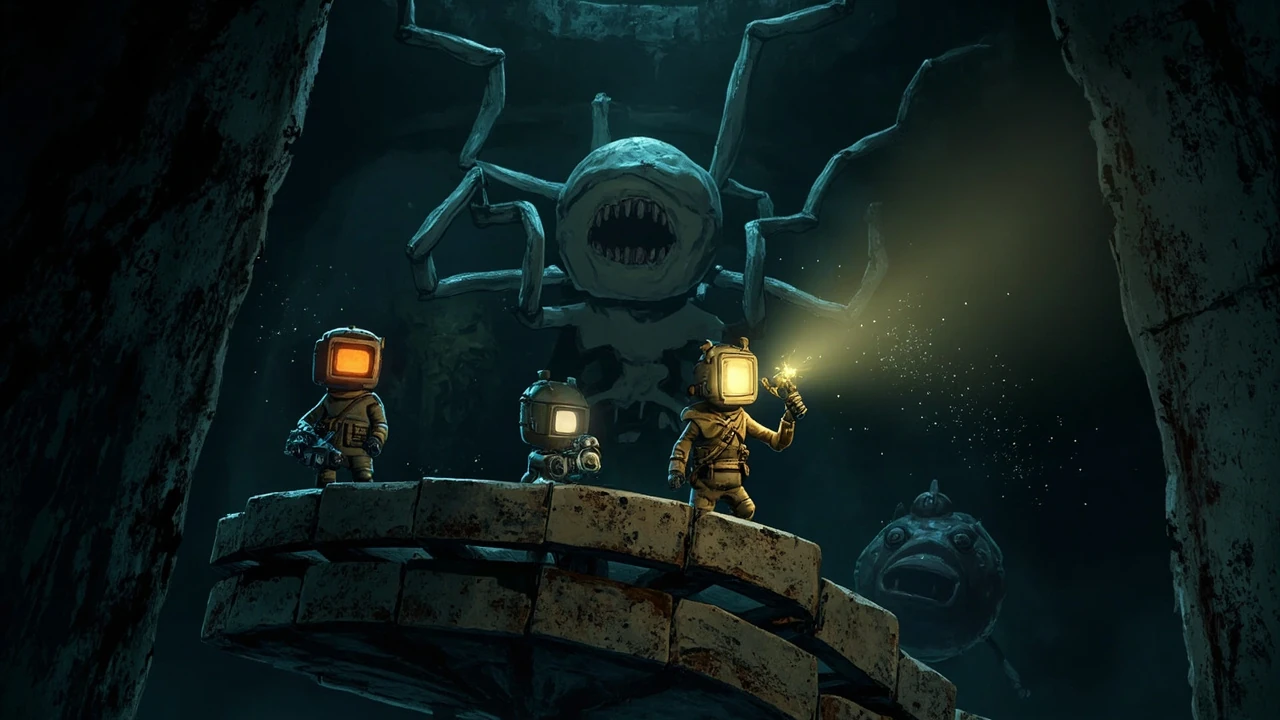
Content warning monsters: what you are actually up against underground
The first time a friend in a four-player lobby screams, runs past the exit ladder, and dies to something that was already in the room, it is rarely because the game is unfair. It is because content warning monsters follow a small set of rules that most players only learn by losing a run. Content Warning is a 2024 co-op horror game developed by Landfall, in which up to four players descend into the Old World with a limited amount of oxygen and a hand-held movie camera. The goal is not to fight the things in the dark. The goal is to film them, climb back to the surface, and upload enough entertaining footage to pay rent before the deadline. The monsters are the obstacle that makes that hard.
This guide is for players and small content teams who want a practical understanding of the enemies they will meet. It explains how encounters are seeded, how each monster behaves, what the realistic counter-play options are, and where the escape starts to break down. The advice is based on the version of Content Warning available through Steam as of early 2026. Several monsters have had balance changes since release, so behaviour notes here reflect wider community-observed patterns rather than a single patch. Where a creature’s behaviour depends on difficulty, host settings, or randomness, that limitation is called out instead of smoothed over.
Looking at content warning monsters is also a useful case study in how co-op horror is designed. The creatures are simple, mostly silent until they are not, and they punish split parties. That makes the game an accessible reference for tension built from limited mechanics, which is why so many small studios use it when prototyping similar experiences. If you are a developer, the monster-by-monster breakdown below doubles as a checklist of the design problems each creature is solving.
How monster encounters work in Content Warning
Before looking at each creature individually, it helps to understand the system they live in. Content Warning uses a relatively small set of encounter rules, and every monster interacts with them in slightly different ways.
Day, night, and depth structure
Each expedition starts in the lobby, then drops the team through a hole in the ground into the Old World. The world is a procedurally arranged series of connected rooms, tunnels, and larger chambers, with a surface hub layered on top. The encounter rules change in three ways as you move deeper:
- Surface levels are safe and contain no monsters, only the entrance hole, the return ladder, and the upload station.
- Upper underground levels are lightly populated. They contain resources, smaller monsters, and the first signs of bigger ones.
- Lower underground levels, reached through elevator shafts, deep staircases, or the large open pits, are where the most dangerous creatures spawn and where oxygen drains faster.
The “day” cycle in Content Warning is not a clock, it is a fixed expedition limit. The team has a finite amount of oxygen that ticks down every second and accelerates at depth. When oxygen runs out, players take continuous damage until the run ends. The monsters, the dark, the oxygen, and the time to upload all interact, so reading a room is not optional.
Spawning rules you can rely on
Several spawning patterns show up run after run, even when the map is different. These are useful baselines, not absolute guarantees.
- Most content warning monsters spawn at fixed points in the level layout, not as random spawn-ins behind the player. If a room is empty when you enter it, it usually stays empty for that run.
- A small set of monsters are roamers and will move between rooms on their own schedule, including toward the camera operator if a camera is filming them.
- Light is the single biggest deterrent. A flashlight aimed at almost any monster will freeze it, slow it, or break its chase, depending on the creature.
- Sound matters. Walking, running, screaming into the mic, and the camera’s own recording beep can change how monsters react, especially the angler-style creatures that hunt by noise.
- Most monsters cannot open doors, but they will wait outside a closed door and break it if given time. Doors are short cooldowns, not permanent barriers.
Why the camera changes everything
The recording camera is not a weapon, but it is the loudest tool the team has. Several monsters react to being filmed, and a few are actively drawn to the camera operator. This creates a tactical tension: filming is how you get views and earn money, but it is also how you attract attention. The safest runs usually assign one player to lighting and one to camera, with the other two handling movement and oxygen timing.
The full content warning monster list and what each one does
The monster roster in Content Warning is smaller than the meme culture around the game suggests, but each entry is tuned to a different failure mode. The list below covers the creatures that are commonly encountered in normal public lobbies as of the most recent updates. If a monster is missing from your version, it has likely been moved to a seasonal mode, restricted to custom lobbies, or rebalanced into a different creature.
Bombs
Bombs are small, round creatures with a fuse on top of their heads. They wander the underground in loose groups, often near doorways and in rooms that also contain loot. They are passive until a player gets close, at which point the lit fuse becomes visible and starts counting down. The counter is short enough that panic is the wrong response.
How to handle them:
- Do not shoot or melee a Bomb. Damage triggers an instant explosion that damages everyone in a small radius, including the shooter.
- Back away slowly until the fuse expires. The Bomb will detonate in place and damage walls and other monsters, but not the player who kept distance.
- If a group of Bombs is blocking a doorway, wait. The chain detonations often clear the path without any team damage.
- Bombs cannot open doors, so a closed door is a reliable way to reset a room that has them.
From a design point of view, Bombs are a tutorial for restraint. They also act as soft crowd control, because players who try to clear a room quickly will reliably blow themselves up.
Slimes
Slimes are slow, low-health blobs that hop around the floor and leave small puddles. They are not dangerous on their own. The threat is that the puddles persist, slow players who walk through them, and stack up to a size that blocks a doorway.
Practical response:
- Keep one player on cleanup duty with a melee weapon. A single swing clears a Slime without creating a puddle.
- Walk around puddles rather than through them. The slow effect is short, but it stacks with other debuffs and can be the difference between outrunning a chaser and not.
- If the room is full of Slimes, film from a safe corner and let the rest of the team clear before approaching the loot.
Angler
The Angler is the first monster most teams learn to fear. It looks like a hunched, pale figure with a glowing lure dangling from its head. The lure emits a constant hum and pulses with light, and the Angler uses that lure to track noise. It hunts by sound more than sight, which means a quiet team can walk past it. A team shouting into the microphone cannot.
Counter-play is straightforward in theory and hard in practice:
- Stop talking, stop running, and crouch-walk past the lure radius. Crouching reduces footstep volume significantly.
- If the Angler is between you and the next room, throw a small distraction such as a thrown rock or a teammate acting as bait at range. Anglers prioritise whatever makes the most noise in the shortest window.
- Do not use the camera near an Angler unless you are ready to leave. The recording beep is enough to draw it.
- Flashlights have a strong slowing effect, but they also make you a target. Use them only when the Angler is already alerted.
The Angler weaponises voice chat, which is the genre’s signature, and forces teams to plan around the loudest player in the lobby.
Giant
The Giant is a tall, dark humanoid that patrols the larger chambers. It is the closest thing the game has to a boss, and it is the reason most teams avoid the deep levels on the first day. Giants are slow, but they hit hard, have a lot of health, and do not flinch from most weapons.
How to deal with a Giant depends on whether you have to:
- If you only need to pass through its room, do not engage. Sprint past using the doorway, close the door, and keep moving. Giants will not chase through a closed door immediately.
- If you need the loot in the room, assign one player to bait the Giant into a chase loop around the central pillars while the others grab the chest and the camera operator films the confrontation from a safe angle.
- Stun grenades, when available, briefly stagger Giants. Use them on the entry to a room if the rest of the team is still setting up.
- Never try to kill a Giant with melee. It is possible, but it is a time loss that almost always costs more oxygen than the loot is worth.
The Giant is the test of whether a team can split tasks under pressure. The team that tries to clear it usually runs out of air mid-fight.
Snatchers
Snatchers are fast, low-to-the-ground creatures that grab players and drag them back to a nest. They are not durable, but they are quick, and they spawn in groups. A Snatcher’s grab does not kill a player outright. It drags them toward a den, and the damage happens gradually. The rescue mechanic is simple: a teammate can melee the Snatcher to release the grabbed player.
Team tactics:
- Keep formation tight in Snatcher-heavy rooms. The grab starts with a short wind-up that a teammate can interrupt if they are within melee range.
- Do not stand in chokepoints. Snatchers love narrow doorways because grabs in doorways cannot be rescued from the other side.
- After a rescue, both players should retreat together. Snatchers will re-grab a player who has just been released.
Eye Guys
Eye Guys are humanoid creatures whose heads are dominated by a single large eye. They are the only monster in the base roster that uses true line-of-sight. When the Eye Guy sees a player, it raises a loud alarm that alerts every monster in the level to the player’s position. This is the monster that turns a quiet run into a chase run.
What works against them:
- Do not look directly at an Eye Guy. Peripheral vision still counts as seeing for the monster, but only barely, and a quick glance is enough to trigger the alert.
- Use the wall to break line of sight before the alert animation finishes. The alert takes roughly one second to play out. If you are behind cover in that second, the broadcast is cancelled.
- Eliminate Eye Guys first when entering a room. They are fragile and die in one or two melee hits, but they are a high-priority target because their alert is a team-wide problem.
The Eye Guy is also the cleanest example of “information monster” design in the game. It does not need to be deadly on its own. The danger is the data it sends to everything else.
Harvesters
Harvesters are tall, pale, eyeless creatures that wander the deeper levels. They are slow and easy to outrun, but they have one defining behaviour: they pick up dead bodies. If a teammate dies in a Harvester’s patrol area, the Harvester will eventually carry the corpse to a ritual spot and remove it from the respawn queue. This makes Harvesters a long-term threat to the team’s recovery options.
Practical rules:
- Retrieve dead teammates as fast as possible. The window before a Harvester notices a corpse is short, often less than a minute.
- If a body has already been taken, do not chase the Harvester. The corpse is gone for the run. Focus on the remaining players and decide whether to keep going or surface.
- Light stuns Harvesters. A flashlight beam in their eyes stops them for a few seconds, which is enough to recover a body or retreat.
Mimics
Mimics disguise themselves as loot chests, and they are the monster that most often ends a run through greed. They do not move, they do not make noise, and they only reveal themselves when a player gets close. The bite is instant and lethal from full health in most cases.
The counter is discipline:
- Never open a chest without a teammate watching from a safe distance with a weapon drawn.
- Hit a chest once with a melee swing before opening it. A real chest will not react. A Mimic will flinch, giving you time to back off.
- Some Mimics are placed in obvious trap spots, such as dead-end rooms with a single chest in the centre. Be especially careful in those.
Watcher
The Watcher is a small creature that clings to ceilings and stays still until something moves under it. It does not attack, but it makes a high-pitched noise that attracts other monsters to its position. The Watcher is the most common cause of “where did all these enemies come from” in casual lobbies.
How to deal with Watchers:
- Look up when entering any room with a ceiling. Watchers are easier to spot in good lighting, which is one more reason to keep a flashlight on in unknown areas.
- Shoot Watchers from range. A single hit kills them and silences the attractor noise.
- If you are already under a Watcher, do not stop moving. Keep walking at a steady pace and exit its trigger radius. The alarm only fires on sudden changes in motion.
Comparison table: how the base monsters differ in role and counter
The table below summarises the role each monster plays in a typical run, what its primary counter is, and the failure mode it is designed to create. Roles are based on the behaviour that shows up most often in normal public lobbies, not on edge cases.
| Monster | Hunt trigger | Primary counter | Failure mode it creates | Typical depth |
|---|---|---|---|---|
| Bombs | Proximity | Back away before fuse expires | Self-damage from panicked melee | Surface to mid |
| Slimes | None, passive | Melee cleanup | Slowed players in chokepoints | Surface to mid |
| Angler | Sound, especially voice | Crouch and stay quiet | Loud teams drawing chases | Mid |
| Giant | Sight and sound | Bait and sprint past | Long fights burning oxygen | Deep |
| Snatchers | Proximity | Tight formation, melee rescue | Split teams losing members | Mid to deep |
| Eye Guys | Direct line of sight | Avoid eye contact, eliminate first | Team-wide alerts | Mid to deep |
| Harvesters | Patrol, body proximity | Fast body retrieval, light stun | Permanent loss of respawn bodies | Deep |
| Mimics | Chest interaction | Test chests with a melee swing | Greed kills in one bite | Surface to deep |
| Watcher | Sudden motion | Look up, shoot from range | Surprise reinforcements | Mid to deep |
Run phases and which monsters dominate each one
Talking about monsters in isolation is useful, but a run in Content Warning is a sequence of phases, and the dangerous creature in each phase is different. A team that plans for the current phase rather than the worst-case monster usually extracts with more footage and fewer deaths.
Surface prep and first descent
The first minute of a run is the safest. Surface rooms contain no monsters, only the entrance shaft and the return ladder. The mistakes here are almost always about equipment, not enemies. A team that forgets to grab a spare battery, or that drops the camera down the shaft, often enters the underground without the tools that make the next phase manageable.
Upper underground: resource rooms
The upper underground is dominated by Slimes, the occasional Bomb, and the first Mimics. Counter-play is mostly discipline. Clear the room before opening chests, test every chest with a melee swing, and back away from Bombs rather than swinging at them. The biggest threat in this phase is internal: a team that fights everything will run out of time and oxygen before reaching the deeper levels where the real money is.
Mid underground: the chokepoints
This is where the Angler, the Snatchers, and the Eye Guys appear. The mid-game is also where teams tend to split up, because the tunnels branch. Community-run data strongly suggests that the safest mid-game plan is to stay in a tight group, walk, and let the camera operator film at a safe distance. Splitting up is the most common way a run collapses before the deep level.
Deep underground: Giants and Harvesters
The deepest chambers are dominated by Giants, Harvesters, and an increased density of Watchers. The deep game is not about killing monsters, it is about getting in, grabbing the high-value loot, and getting out. A run that tries to clear the deep level is almost always a run that fails to upload.
The return trip
Ironically, the return trip is often the most dangerous part of the expedition. The team is low on oxygen, the loot slows them down, and every monster that was bypassed on the way in is now between them and the ladder. A few rules keep the return manageable:
- Surface the moment oxygen drops below 30 percent, even if it means leaving loot behind.
- Assign a single runner to carry the camera and another to carry the heaviest item, with the rest of the team acting as a screen.
- If a monster blocks the only return tunnel, do not fight it. Back up, find another route, and accept the time loss.
- Keep at least one flashlight on the return path. Light is the only thing that resets most chases.
Build, role, and loadout decisions that change monster priorities
Player loadouts and host settings change which monster is the priority threat. The same room that is trivial with a four-person team can be a death sentence for a solo player, and a custom lobby that disables specific monsters can completely change the optimal route. The list below maps common configuration choices to the monster they affect most.
- Voice chat on: Anglers and Watchers become priority threats. Use push-to-talk or stay quiet in monster-dense rooms.
- Voice chat off: Anglers are mostly harmless. Snatchers and Eye Guys become the dominant threat because there is no noise to mask a player’s footsteps.
- Lower oxygen timer: Giants and Harvesters become a hard skip. Deep-level loot is rarely worth the time spent.
- Higher difficulty: Mimics appear earlier and in clusters. Treat every chest as a threat, even in upper levels.
- Solo or two-player runs: Snatchers are nearly unblockable. Skip rooms where they can drag a player into a dead end.
Common monster mistakes and how to fix them
Most failed runs in Content Warning are not caused by a single bad encounter. They are the result of a small habit that compounds. The list below covers the most common mistakes observed in public lobbies and the practical fix for each.
- Spraying melee at every monster. Bombs and Mimics punish this. Default to light and distance first, then decide if a fight is worth the time.
- Letting one player do all the filming. Spread the camera time. A team that is all lit up but never recorded uploads no footage.
- Opening chests in the dark. Mimics love an unlit chest. Light the room and test the chest with a single swing before opening.
- Yelling during an Angler chase. The voice that caused the chase cannot be the voice that solves it. Mute, crouch, and let the Angler reset.
- Ignoring a dead teammate. Harvesters, Snatchers, and the oxygen timer all punish slow retrievals. Treat a downed teammate as a thirty-second problem.
- Greeding the deep level. The loot is good, but the cost of a lost camera is higher. Set a hard oxygen limit and stick to it.
- Forgetting the surface. A successful run ends at the upload station, not at the deepest chest. Plan the return route before going down.
What to do when a run is already going wrong
Even disciplined teams have bad runs. The recovery plan matters as much as the opening plan. The flow below is the one most experienced players use, in order.
- Stop. If the team is panicking, the right move is to stop, hold position, and let the monsters reset their aggro.
- Re-light. Get a flashlight pointed at the immediate threat. Most chases end within a few seconds of a strong light source.
- Re-group. Confirm who is alive, who has the camera, and who has the heaviest loot. Decide as a team whether to push or surface.
- Cut bait. Leave any loot that is not on the return path. Time and oxygen are worth more than items in a bad run.
- Surface. Head for the ladder. If the ladder is contested, choose the safest available exit and accept the smaller payout.
- Upload. A small upload is still a payout. The goal of a recovery is to bank something, not to make the day perfect.
Content warning monsters as a design reference
For developers, the monster roster is a compact example of role design. Each creature occupies a slot in the encounter table, and the slots are well separated:
- Bombs teach restraint.
- Slimes teach area denial.
- Anglers teach audio discipline.
- Snatchers teach team formation.
- Eye Guys teach line-of-sight awareness.
- Giants teach encounter avoidance.
- Harvesters teach consequence management.
- Mimics teach caution with reward.
- Watchers teach threat reading.
If you are prototyping a similar co-op horror experience, the content warning monsters list is a useful starting checklist. Each creature solves a specific design problem, and most of them are cheap to implement in a prototype because they share the same animation rig and a small handful of behaviour states. A practical way to test whether your design supports the same kind of emergent play is to ask whether your team can describe each monster in one sentence and what its counter is. If the answer is “they are all fast and you shoot them,” the encounter design probably needs more separation between roles.
For broader comparison and a wider list of community-reported strategies, the Eurogamer guide to all monsters in Content Warning and how to escape them is a useful cross-check, especially when balancing a custom run against a public one. For accessible background on the genre, the Wikipedia entry for Content Warning covers the game’s release context and core loop, which helps when comparing its monster design to other co-op horror titles.
How monster balance has changed and what to watch next
Content Warning launched in 2024 and has had several updates through 2025 and into 2026, mostly focused on stability, lobby management, and the in-game economy rather than monster reworks. A few balance shifts are worth knowing about:
- Angler detection radii have been tweaked in custom lobbies. The default public setting still uses the original radius.
- Mimic damage has been reduced in some patches, but the one-hit lethality on a full-health player is still the default in public matches.
- Harvester body-removal speed has been increased in at least one patch, which raises the cost of leaving a body behind.
- Seasonal modes, especially around April and October, often add themed monsters with their own rules. These do not appear in the base roster and are usually limited-time.
For long-term planning, the safest assumption is that the monster list and behaviour will continue to evolve with community feedback. The roles described in this article are stable, but specific damage numbers, aggro radii, and spawn density should be re-checked in the patch notes that match the version you are playing.
Behaviour at a glance: run-phase reference table
The table below pairs each run phase with the monsters that usually dominate it, the resource pressure in play, and the team action that most often keeps the run alive. Use it as a quick reference between runs.
| Run phase | Dominant monsters | Main pressure | Team action that works |
|---|---|---|---|
| Surface prep and first descent | None | Equipment mistakes | Grab a spare battery, carry the camera, mark the return ladder |
| Upper underground resource rooms | Slimes, Bombs, first Mimics | Slow oxygen drain, loot greed | Test every chest, back away from Bombs, do not fight Slimes in groups |
| Mid underground chokepoints | Angler, Snatchers, Eye Guys | Sound-based chases, split parties | Stay grouped, crouch past Anglers, break Eye Guy line of sight |
| Deep underground chambers | Giants, Harvesters, dense Watchers | Fast oxygen drain, body loss | Bait Giants past loot, retrieve bodies inside one minute, film from a safe angle |
| Return trip to the ladder | Every monster bypassed on the way in | Low oxygen, heavy loot, contested exits | Surface at 30 percent oxygen, keep a flashlight on the return path, accept smaller payouts |
Frequently asked questions
How many monsters are in Content Warning?
The base roster has nine monsters as of the most recent updates: Bombs, Slimes, Angler, Giant, Snatchers, Eye Guys, Harvesters, Mimics, and Watchers. Seasonal modes sometimes add limited-time creatures, but those do not appear in standard public lobbies.
Which content warning monster is the most dangerous?
For most teams, the Giant is the single most dangerous monster because it requires the most oxygen to bypass and punishes fights more than any other creature. The Angler is the most common run-ender in casual lobbies, however, because voice chat makes it almost impossible to avoid.
Can you kill the Giant in Content Warning?
Yes, but it is rarely worth it. The Giant has high health, does not flinch from most weapons, and the time it takes to kill usually costs more oxygen than the room’s loot is worth. Most experienced players bait it away from the loot and sprint past.
Do monsters in Content Warning respawn after a run?
Within a single expedition, monsters do not respawn once a room is cleared. A new expedition generates a fresh layout with a new monster distribution, so encounters are not persistent between runs.
What does the camera do to monsters in Content Warning?
The recording camera does not harm monsters, but it does attract attention. Anglers and Watchers in particular will move toward the camera operator, and the recording beep can trigger an Eye Guy’s alert. The camera is a tool for earning money, not a weapon.
Are there monsters in the surface levels of Content Warning?
No. The surface is always safe and only contains the entrance shaft, the return ladder, the upload station, and the team’s spawn point. Monsters only appear underground.
Do doors stop monsters in Content Warning?
Doors do not block monsters permanently. Most creatures will break a door if given time, but a closed door does reset most chases and gives the team a few seconds to reposition.
Is there a way to make Content Warning easier for a new team?
Custom lobbies allow the host to change the oxygen timer, the loot density, and the monster distribution. A new team usually benefits from a longer timer, fewer Giants, and a forced four-player squad. There is no official easy mode, but the host settings cover the same ground.
What is the safest way to deal with a Mimic chest?
Hit the chest once with a melee weapon before opening it. A real chest will not react. A Mimic will flinch, which gives the team a second to back off before the bite. Always have a teammate watching from a safe distance when a chest is opened.
Do seasonal monsters change the escape strategy?
Usually yes. Limited-time monsters typically have unique triggers, and the optimal route through the underground can change entirely. Check the seasonal patch notes before running a themed mode, and assume the usual monster priorities may not apply.
Leave a Reply