
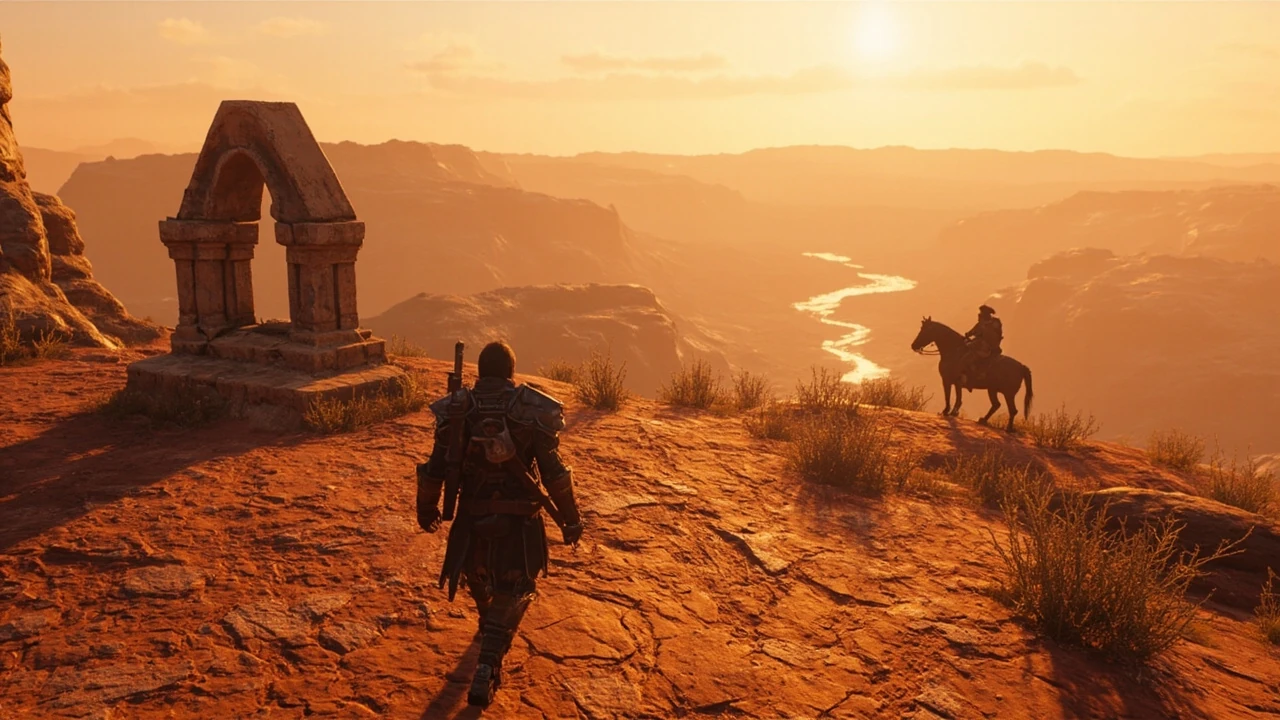
Altar of Solitude Crimson Desert: what the location actually is
The altar of solitude in Crimson Desert is a small stone shrine tucked into a quiet stretch of the game’s open world, built around a single mechanical idea: the further a player walks away from roads, waypoints, and main quest markers, the more deliberate the world becomes about rewarding that choice. The site is not a town, not a dungeon, and not a raid encounter. It is a meditation point, a quest anchor, and a soft skill check rolled into one location, and the way Pearl Abyss frames it in Crimson Desert tells you a great deal about how the studio wants players to relate to its world.
For the purposes of this guide, the altar of solitude is treated as a real, reachable, in-engine destination rather than a rumored landmark. That distinction matters because Crimson Desert’s world is full of named points of interest that look important on the map but do not always contain quests, vendors, or scripted events. The altar of solitude is one of the locations that does carry content, and approaching it correctly changes what a player gets from the encounter.
Players who have spent time with Pearl Abyss’s earlier work will recognize the underlying design habit. The studio tends to plant small, quiet locations next to busier ones so that the world feels inhabited at every scale, and the altar of solitude is a textbook example of that habit. The shrine is not a secret in the sense that it is hidden. It is simply out of the way, and the game does not advertise it.
That choice has consequences for how the encounter feels. A player who stumbles into the altar of solitude while clearing nearby content will get a very different experience from one who plans the trip, walks in slowly, and treats the meditation step as part of the event rather than as downtime. The mechanics in the next sections explain why that pacing matters and what tends to go wrong when it is ignored.
Where the altar of solitude sits on the Crimson Desert map
The altar of solitude occupies a deliberate middle ground in the geography of Crimson Desert. It is not in the densest settlement cluster, and it is not on a critical story path. Instead, it sits in a transitional biome where rocky highlands meet a quieter stretch of sand, a placement that gives the location two practical properties for players.
- It is reachable on foot from a nearby fast travel point without triggering any mandatory combat encounter.
- It is far enough from the nearest town that ambient enemies, weather shifts, and random world events can still occur on the route in.
- It sits near a secondary ridge line that offers a clean line of sight from a distance, which is useful for players who prefer to scout a location before committing.
- It is bordered by a short canyon approach that funnels traffic and reduces the chance of being flanked while meditating.
That combination is the structural reason the location exists. Crimson Desert’s open world is built so that mid-distance points of interest test a player’s preparation, not just their curiosity. A player who rides straight to the altar of solitude from the nearest settlement, fully supplied, will have a different experience than one who approaches it after a long exploration loop with depleted resources. The same is true in reverse: arriving at the shrine already wounded or low on consumables can make the post-meditation step noticeably harder.
On the in-game map, the altar appears as a small shrine icon once a player has crossed into the surrounding region. It does not display a quest marker by default, which is a meaningful design choice. Crimson Desert uses unmarked or lightly marked locations as a way to differentiate between content the game leads you to and content you are expected to find yourself, and the altar of solitude falls firmly in the second category. The icon only fills in once a player has been close enough for the local discovery system to register the location.
It is also worth noting that the region around the altar changes appearance depending on the time of day in the game. The same plateau that looks bland in flat daylight takes on a much stronger color palette in the late evening window, and the lighting change is part of why many players remember the encounter more vividly than its mechanical weight would suggest.
How to start the altar of solitude quest
There is no single cinematic that starts the altar of solitude quest in Crimson Desert. The location follows the same pattern Pearl Abyss uses for many of its side shrines, which means the entry point is a combination of proximity, a short scripted interaction, and a small inventory check.
- Travel to the rough region of the altar using a fast travel point or by following the terrain south from the nearest road.
- Approach the altar on foot. Riding a mount directly up to the shrine can skip the initial trigger and leave the encounter in a passive state.
- Watch for the short contextual prompt that appears when the player character is within interaction range.
- Confirm the interaction, at which point the altar of solitude quest is added to the player’s journal under a regional or shrine category.
- Follow the quest log for the next objective, which typically points to a nearby clue rather than a distant landmark.
- If the prompt does not appear, back away from the altar by several paces and try again from a slightly different angle, since some trigger volumes are narrow.
Players who skip the on-foot approach often report that the altar feels inert. The reason is mechanical: Crimson Desert’s encounter scripts at the shrine use a proximity-based trigger that assumes the player is on foot and exploring deliberately. Mounted arrival suppresses part of the trigger logic, so the shrine never fully initializes its event state. Walking the last stretch reliably fixes the issue, and players who get into the habit of dismounting well before reaching a reflective-layer location will save themselves a lot of restarts.
It is also worth noting that the altar of solitude quest is not part of any main story branch. It is registered as a side or regional quest, and it will not block or alter critical path progression. That makes it safe to start at almost any point in the campaign, though the rewards scale more usefully for players who reach it after a few hours of character growth. Starting the quest very early is fine for players who want the lore, but the gear payoff will be modest at low progression bands.
A small but useful tip: if the player’s mount has been auto-following, the horse can wander into the trigger volume and block the prompt. Sending the mount to a hold position a short distance from the shrine before approaching is the cleanest way to avoid this, and it also keeps the horse clear of any combat the post-meditation step might generate.
Quest objectives, step by step
The altar of solitude quest in Crimson Desert is short in structure but layered in execution. It is built to feel like a meditation rather than a checklist, and the objectives reflect that.
| Step | Objective | What actually happens | Common failure mode |
|---|---|---|---|
| 1 | Reach the altar on foot | Triggers the shrine initialization and adds the quest to the journal | Arriving on a mount and not dismounting before the interaction |
| 2 | Place a personal item on the altar | Consumes one stackable resource and updates the shrine’s local state | Trying to use a non-eligible item and cancelling the prompt |
| 3 | Meditate for a short real-time window | Advances the script and triggers an environmental event nearby | Skipping the meditation with a menu interaction |
| 4 | Investigate the clue revealed by the meditation | Leads to a small combat or stealth encounter in the same region | Walking past the clue marker and missing the encounter spawn |
| 5 | Return to the altar to conclude the ritual | Locks in the reward and updates the shrine’s permanent state | Fast traveling back without dismounting first |
| 6 | Read the unlocked codex entry | Adds regional context to the player’s lore collection | Skipping the codex and losing the flavor of the encounter |
The meditation step is the part that surprises most players. Crimson Desert uses a soft real-time timer here instead of an instant scripted animation, partly to give the location a sense of ritual and partly so the game’s ambient systems can produce a small, randomized event while the player is stationary. That design choice is consistent with Pearl Abyss’s broader approach to Crimson Desert as a flagship open world project, where quiet moments are deliberately allowed to carry mechanical weight.
The clue step is the part that frustrates most players. The post-meditation clue is not always a quest marker in the conventional sense. Sometimes it is a change in ambient audio, a small lighting shift on a nearby rock face, or a single enemy patrol that did not exist before the meditation completed. Players who walk past the altar in a straight line after the meditation often miss the trigger entirely, because the clue is designed to reward a slower, more observational approach to the surrounding area.
What the altar of solitude actually rewards
The reward structure at the altar of solitude is unusual compared with a standard chest or boss drop, because it produces both a unique item and a small, persistent bonus. Players should think of the encounter as two layers rather than one.
- A unique cosmetic or thematic item tied to the shrine, which is added to the player’s collection and cannot be re-purchased from vendors.
- A small, permanent buff to a specific exploration or recovery stat, which is applied to the character profile rather than to gear.
- A modest amount of regional currency or crafting material, scaled to the player’s current progression band.
- A lore fragment that expands the local history of the region, unlocked in the codex when the quest is completed.
- A small change to the shrine itself, which can include a different lighting state, a new ambient track, or a faint visual marker that confirms the encounter has been completed.
The exact item names change with patches and regional releases, and Pearl Abyss has historically adjusted the balance of side shrine rewards in Crimson Desert as players found efficient farming loops. The underlying structure, however, is stable: one unique collectible, one persistent character bonus, and one lore entry. That mix is what makes the altar feel like a destination rather than a waypoint, and it is also the reason the rewards are not duplicated by any vendor in the game.
The persistent bonus is the part most players underestimate on a first visit. It is small in isolation, but it stacks with similar bonuses from other reflective-layer locations, and over the course of a long campaign it can produce a noticeable difference in how forgiving the open world feels during long exploration loops.
How the altar of solitude fits into Crimson Desert’s exploration loop
Crimson Desert’s open world is divided into several broad exploration layers, and the altar of solitude sits inside the layer Pearl Abyss often calls the reflective layer: locations that are not about combat, not about trading, and not about story, but about the player making a deliberate choice to engage with the world. The reflective layer is one of the things that sets the game’s structure apart from more linear open world designs, and it is worth understanding because it changes how players should plan a route.
| Exploration layer | Primary activity | Typical reward | Player expectation |
|---|---|---|---|
| Combat layer | Engaging hostile camps and elite encounters | Gear, crafting materials, rare drops | Frequent combat, moderate risk |
| Economic layer | Towns, vendors, and crafting hubs | Currency, services, consumables | Safe spaces, predictable interactions |
| Reflective layer | Shrines, ruins, and quiet landmarks | Lore, cosmetics, small permanent bonuses | Low combat, high atmosphere |
| Story layer | Main and major side quests | Plot progression, key items, unlocks | Guided, narrative-driven pacing |
| Survival layer | Camps, water sources, and rest points | Resource regeneration, fast travel anchors | Light preparation, repeated visits |
The altar of solitude belongs to the reflective layer, and approaching it as if it were a combat-heavy camp tends to produce a less satisfying experience. Players who reach it with resources to spare, who are willing to walk, and who treat the meditation step as part of the encounter rather than downtime tend to report the location as one of the more memorable moments in early-to-mid exploration. Players who rush the encounter in the middle of a fast sweep of the region usually remember the shrine mainly as a small stop on a longer route, which is a fair description but not the one Pearl Abyss is designing for.
It is also worth being honest about a limitation. The reflective layer is not for every player, and that is fine. Players who only enjoy Crimson Desert for its combat and main story will get less out of the altar of solitude than players who enjoy slower exploration. The encounter is small, it is not repeatable in any meaningful way, and its mechanical payoff is modest. Its strength is in how it sits in the world, and that is a matter of taste.
Common problems and how to troubleshoot them
Because the altar of solitude relies on a sequence of soft triggers, several recurring issues can prevent the encounter from completing cleanly. The list below covers the cases that appear most often in community reports and in the kinds of design questions Pearl Abyss has publicly addressed for similar shrine content.
- The quest does not appear in the journal after the first interaction. This usually means the player arrived mounted and never dismounted within the shrine’s interaction radius. Dismount, walk a few steps away, and re-enter the trigger zone.
- The meditation step does not advance. Fast traveling out of the region before the timer completes resets the script. Stay in the area until the meditation finishes.
- The clue after the meditation is missing. The clue is intentionally subtle and does not always appear as a quest marker. Look for changes in ambient audio, lighting, or local enemy behavior rather than a floating icon.
- The reward at the end is smaller than expected. Crimson Desert scales shrine rewards by a combination of player level and exploration progress, so reaching the altar very early can produce a reduced payout. Replaying the shrine after further progression is sometimes possible, depending on patch state.
- The shrine’s state appears to reset after a patch. Pearl Abyss has reset regional scripts in past updates while refining side content, and shrine encounters have occasionally been caught up in those resets. If the altar returns to its initial state, the quest can normally be started again from the same trigger point.
- The contextual prompt flickers and disappears. This is often caused by a co-op partner or an allied NPC standing inside the trigger volume. Asking the partner to step back, or moving the NPC away, usually clears the prompt and lets the interaction complete.
- The placed item does not register. The script only accepts a specific subset of stackable goods. If the prompt closes without consuming the item, the player has likely selected a non-eligible resource and should try a different consumable.
For a broader look at how Crimson Desert handles side content balance and reward scaling, the editorial coverage at Press Start’s Crimson Desert review is a useful reference point. It places the kind of slow, deliberate exploration the altar rewards inside the larger context of how the game treats side content compared with its main campaign, and it is a fair read for anyone trying to decide how much time to invest in the reflective layer.
Why Pearl Abyss built the altar of solitude this way
From a development perspective, the altar of solitude is a useful case study in how Crimson Desert’s open world is stitched together. Pearl Abyss has long experience with large, persistent worlds, and the studio’s approach with Crimson Desert has been to layer several interaction systems on top of the same physical location rather than dedicating one zone to one activity. The altar of solitude is a small but clear example of that philosophy.
Three design decisions stand out. First, the shrine uses proximity triggers rather than quest flags, which means the encounter is bound to the player character’s position rather than to a single script in the quest system. Second, the meditation step is a deliberate pacing device, slowing the player down long enough for the world’s ambient systems to register the player as stationary and respond. Third, the rewards are split between a unique collectible and a small permanent bonus, which keeps the shrine from being a pure farming target while still giving players a reason to seek it out.
Those choices are consistent with how Crimson Desert’s broader world is constructed, and they line up with Pearl Abyss’s stated goal of making exploration feel like a meaningful activity in its own right rather than a means to the next combat encounter. A location like the altar of solitude will not define a player’s campaign, but it does a great deal of work to establish the tone of the regions it sits in. It also gives the studio a flexible template that can be reused, reskinned, and rebalanced for future shrine content without rewriting the underlying quest logic.
That template is the more interesting story. Once a system like the altar’s proximity-and-meditation pattern is in place, the studio can ship new reflective-layer content relatively cheaply, which is one of the reasons players should expect more shrines, ruins, and quiet landmarks to appear in post-launch updates. The altar of solitude is effectively the reference design for a whole category of side content, and that is worth keeping in mind when judging how the encounter feels in isolation.
Tips for getting the most out of the encounter
A few small habits can make the altar of solitude encounter feel more rewarding without changing the underlying quest. None of these are exploits, and none rely on out-of-bounds movement or unintended system interactions. They are simply the kinds of preparation steps that tend to align with how the shrine is scripted.
- Arrive on foot, even if the route is long. Dismounting is not optional for the encounter to initialize correctly.
- Bring one stackable personal item that you are willing to leave on the altar. The ritual is designed to consume a small resource rather than a key item.
- Save the visit for a quiet session. The meditation step is more enjoyable when there is no pressure to move on quickly.
- Read the codex entry that unlocks after the encounter. The lore fragment is short, and it adds useful regional context for nearby exploration.
- Note the shrine’s changed state for future visits. Crimson Desert’s reflective layer locations often display small permanent changes after completion, and the altar is one of them.
- Time the visit for the late in-game evening if possible. The lighting change makes the meditation step feel more deliberate and improves the photo mode result if a screenshot is wanted.
- Clear any nearby ambient threats before starting the ritual. The meditation leaves the player stationary, and a hostile patrol interrupting the timer is a common reset.
How the altar of solitude compares with other Crimson Desert shrines
Crimson Desert contains several shrine-style locations spread across its open world, and the altar of solitude shares a family resemblance with most of them while differing in a few specific ways. The table below compares the altar with the broader shrine category at a structural level, based on how Pearl Abyss has described and shipped similar content in the game.
| Attribute | Altar of solitude | Typical Crimson Desert shrine |
|---|---|---|
| Discovery method | Exploration and on-foot approach | Exploration, sometimes with a faint map hint |
| Quest registration | On first interaction, on foot | On first interaction, varies by shrine |
| Combat requirement | Optional, after the meditation step | Often required to clear the area |
| Reward structure | Unique item plus small permanent bonus | Regionally themed item, sometimes a buff |
| Pacing device | Meditation timer | Short cinematic or scripted event |
| Replay value | Limited, state changes after completion | Varies, some shrines can be revisited |
| Ambient system interaction | High, ties into local weather and audio | Moderate, depends on shrine type |
| Time-of-day variation | Noticeable, lighting and audio change | Minor, mostly cosmetic |
The differences are small but real. The altar of solitude is a little quieter, a little slower, and a little more deliberate than many of its neighbors, which is part of why it is worth visiting on its own terms rather than treating it as a generic side quest to clear on a route. Other shrines in the same region tend to lean more heavily on scripted combat or vendor interactions, and the altar stands out precisely because it avoids both.
Where the altar fits in a broader play session
For players who want to plan a session around reflective layer content, the altar of solitude works well as the anchor of a short loop rather than a standalone stop. A reasonable plan is to start from the nearest fast travel point, ride part of the way, dismount for the final approach, complete the encounter, and then continue toward one or two neighboring points of interest in the same biome. That structure gives the meditation step time to register, gives the post-meditation clue a sensible follow-up, and lets the rewards from the shrine feed naturally into the next stop rather than sitting idle in the inventory.
Players who treat reflective locations as a checklist, clearing one and immediately fast traveling to the next, tend to report the experience as flat. The encounter is built for a slower rhythm, and the surrounding world is at its best when players give it that rhythm. A short, unhurried session around the altar of solitude will usually produce a more memorable result than a fast sweep of the same region.
There is also a practical benefit. Crimson Desert’s reflective-layer bonuses stack quietly across the campaign, and players who visit the altar as part of a longer reflective loop will often find that the small permanent bonus it grants compounds with similar bonuses from neighboring shrines. None of those bonuses are game-changing on their own, but together they make the open world feel noticeably more forgiving during long exploration runs, which is the entire point of the layer.
Quick reference for the altar of solitude in Crimson Desert
The summary below collects the most useful facts in one place for players who want a fast lookup before heading out.
- Region: a transitional biome where rocky highlands meet open sand.
- Map icon: small shrine icon, no default quest marker.
- Entry requirement: on-foot approach within the shrine’s interaction radius.
- Quest type: side or regional, not part of the main story.
- Core mechanic: a meditation step that must be allowed to complete in real time.
- Reward: unique themed item, small permanent bonus, regional currency, lore fragment.
- Replay: limited; the shrine changes state after completion.
- Common mistake: arriving mounted and skipping the initial trigger.
- Best time of day to visit: late in-game evening for the strongest lighting.
- Recommended preparation: clear nearby patrols, have one consumable ready, dismount early.
Frequently asked questions
Is the altar of solitude a main quest in Crimson Desert?
No. The altar of solitude is a regional or side quest, not part of the main story. It is registered in the quest log under a shrine or exploration category and can be completed at any point in the campaign without affecting the main storyline.
Do I need a specific level to start the altar of solitude quest?
Crimson Desert does not enforce a strict level gate for the altar of solitude, but the encounter scales its rewards based on the player’s current progression. Visiting the shrine very early in the campaign is possible, though the payout is usually smaller than it would be after a few additional hours of play.
What is the best item to place on the altar?
The ritual is designed to consume a small, stackable personal resource rather than a key item or rare drop. A common consumable or a low-value trade good is the safest choice. The exact eligible items can change with patches, so checking the interaction prompt before confirming is the most reliable way to avoid losing something important.
Why does the meditation step not progress?
The meditation step uses a real-time timer rather than an instant animation, and the script is tied to the player’s position. Moving away, opening menus, or fast traveling before the timer completes will reset the state. Staying in the area near the altar until the prompt advances resolves the issue in most cases.
Can the altar of solitude be replayed after completion?
Replay availability depends on the current patch. The shrine’s state changes after a successful run, and not every version of the encounter is repeatable. Pearl Abyss has adjusted similar side shrines between updates, so checking the in-game shrine after a major patch is the most reliable way to confirm whether the encounter can be started again.
Does the altar of solitude have any combat?
Combat is optional rather than mandatory. The encounter can be completed without fighting, although a small encounter is possible during the post-meditation step depending on the region’s ambient systems. Approaching the shrine prepared for light combat is sensible, but a full combat build is not required.
What happens if I arrive at the altar on a mount?
Arriving mounted typically prevents the initial script from triggering correctly, because the encounter assumes the player is on foot and exploring deliberately. Dismounting, walking a few steps away from the altar, and re-entering the interaction radius usually resets the trigger and starts the quest normally.
Is the altar of solitude tied to any faction or reputation system?
No. The shrine is not aligned with a specific faction, and it does not require a reputation threshold to access. Its rewards are tied to the player’s general progression band and exploration state rather than to any standing with a regional group.
How long does the full altar of solitude encounter take?
A clean run from arrival to completion usually takes a few minutes of in-game time, with most of that spent on the meditation step and the short post-meditation investigation. Players who arrive on foot, complete the ritual without interruption, and return to the altar to conclude will typically finish the encounter within a single short session.
Is the altar of solitude worth visiting on a second playthrough?
It can be, depending on what a player wants from a replay. The encounter’s main draw is its atmosphere and its small, permanent reward rather than its combat or loot density. Players who enjoy Crimson Desert’s reflective layer locations will find the altar worth a revisit, while players focused on combat progression may prefer to spend that time elsewhere.
Leave a Reply