
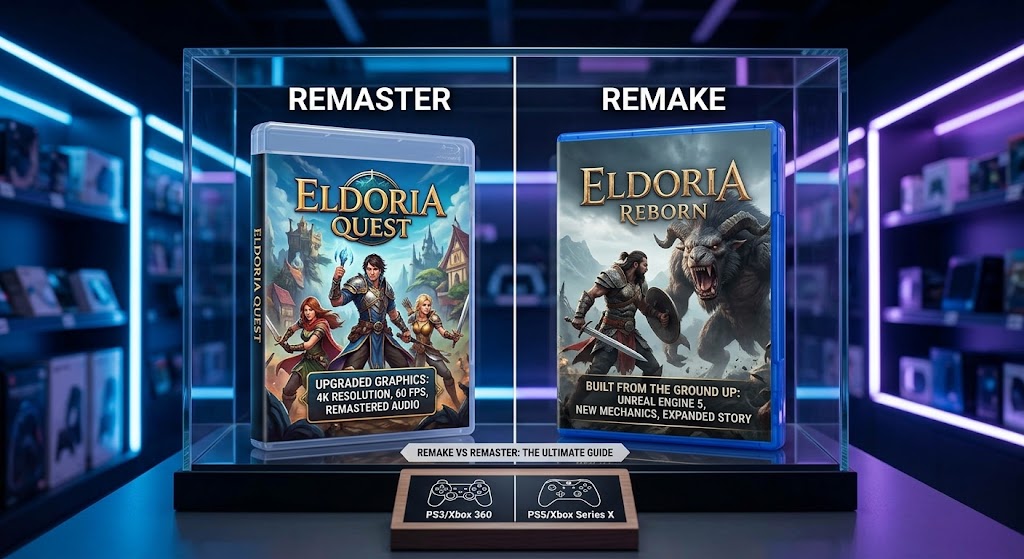
Remake vs Remaster: Understanding the Big Differences in Video Games
You sit down at your console or PC, glance at the store page, and see a familiar title from your childhood. The store page calls it a shiny new release, but the word attached to the title makes you pause. Is it a remake, or is it a remaster?
The gaming industry loves revisiting classic titles. Nostalgia sells, and bringing legendary adventures to modern hardware makes financial sense. But marketing teams often blur the lines between these terms, leaving players confused about what they are actually buying.
Understanding the distinction between a remake vs remaster helps you set realistic expectations before dropping fifty or seventy dollars on a game you might have already played a decade ago. It changes how you judge the visuals, performance, and gameplay tweaks.
Let us break down what these terms actually mean, how studios approach them, and why the line sometimes feels blurry.
What Is a Video Game Remaster?
A remaster takes an existing, fully built game and upgrades its presentation for newer hardware. Think of it like taking an old movie print and scanning it in 4K resolution. The actors, script, and camera angles stay identical, but the image gets sharper.
In game development, a remaster works with the original source code and game engine. Developers do not rebuild the game logic from scratch. Instead, they bump up texture resolutions, improve lighting effects, clean up sound files, and target higher frame rates.
Sometimes they add quality-of-life adjustments. They might tweak control schemes to match modern controllers, shorten loading times, or update screen resolution support for widescreen and ultra-wide displays.
Here is what typically happens during a remaster project:
- Upgrading texture quality from standard resolution to HD or 4K textures.
- Increasing frame rate targets from 30 FPS to 60 FPS or higher.
- Enhancing audio quality by re-mixing sound effects and original soundtracks.
- Adjusting lighting systems and adding basic modern shaders.
- Fixing long-standing technical bugs present in the original software release.
Remasters are great because they preserve the exact feel of the original experience while eliminating technical friction caused by aging hardware. You get the same game you loved, just running smoother and looking cleaner on your current monitor.
What Is a Video Game Remake?
A remake is a complete reconstruction of a game from the ground up. Developers do not just polish old files; they open a fresh project file in a modern engine like Unreal Engine 5 or a custom proprietary tool and rebuild everything.
Character models, environments, physics systems, and voice acting are created anew. Mechanics are redesigned to align with modern game design standards. Sometimes storylines are expanded, altered, or completely reinterpreted.
A remake treats the original title as a blueprint rather than a base asset. The developers look at what made the original special and ask how they can replicate that feeling using today’s technology.
Consider these core traits of a remake project:
- Building brand-new art assets, character models, and environments from scratch.
- Rewriting or heavily updating the game engine code for modern physics and movement.
- Re-recording dialogue with new or returning voice actors using modern equipment.
- Overhauling core gameplay mechanics, camera angles, and combat systems.
- Adding new story scenes, quests, or expanding existing lore elements.
When you play a remake, you are playing a brand-new video game that shares a story, world, and name with a classic title. The experience feels fresh even if you know the narrative beats by heart.
Core Comparison: Mechanics, Graphics, and Engine Code in Remake vs Remaster Projects
To truly grasp how these two approaches differ, we need to compare their fundamental components side by side. Development scope, financial budget, and technical execution vary wildly between them.
A remaster focuses on preservation and enhancement. The core logic remains untouched. If a jump felt floaty in 2004, it will likely feel floaty in the remaster, just running at 120 frames per second.
A remake focuses on reimagining and modernization. If a jump felt floaty in 2004, the developers will likely rewrite the movement code to make character handling crisp and responsive for modern standards.
Look at this side-by-side technical breakdown to see how each approach handles critical game elements:
| Feature Aspect | Remaster Approach | Remake Approach |
|---|---|---|
| Game Engine | Original engine retained and patched | Brand new modern engine built or adopted |
| Source Code | Original source code modified | New code written from scratch |
| Visual Assets | Original textures upscaled or retouched | New 3D models, textures, and animations |
| Gameplay Mechanics | Preserved with minor controller tweaks | Overhauled, modernized, or redesigned |
| Voice & Audio | Original audio cleaned up and re-mixed | Re-recorded voice work and dynamic audio |
| Development Time | 6 months to 2 years typically | 3 to 5+ years typically |
| Average Cost | Lower budget investment | Full AAA development budget |
This table highlights why remasters cost less and release faster. They do not require hundreds of artists to sculpt millions of polygons from scratch. They refine what already exists.
Remakes, on the other hand, require full development teams including conceptual artists, level designers, combat engineers, and narrative directors working for several years.
Why Publishers Choose One Over the Other
Deciding between a remake vs remaster comes down to business strategy, game age, and fan demand. Both approaches serve distinct purposes in a publisher’s long-term portfolio.
A remaster is ideal for bridging console generations. When a new PlayStation or Xbox launches, players want to enjoy late-era hits from the previous system without keeping old consoles plugged into their TV.
It is also a low-risk way for studios to gauge market interest in an dormant franchise. If a budget remaster sells well, executives might greenlight a full sequel or a massive remake project later on.
Remakes are chosen when a game’s underlying mechanics or visuals have aged so poorly that a simple coat of paint will not satisfy modern audiences. Early 3D games from the late 1990s often fall into this category.
Fixed camera angles, tank controls, and low-polygon models can feel unplayable to younger gamers used to fluid dual-analog movement. Rebuilding those titles opens them up to a whole new generation of buyers.
Here are primary reasons studios choose a remaster:
- Preserving historical titles on modern digital storefronts and platforms.
- Providing quick revenue streams between major studio releases.
- Testing consumer demand for forgotten or dormant intellectual properties.
Here is why studios commit to a remake instead:
- Revitalizing outdated gameplay systems that modern players find frustrating.
- Capitalizing on the power of modern GPUs and ray-tracing hardware.
- Expanding existing stories to fix plot holes or add deeper character arcs.
Both strategies keep gaming history alive, but they target different player expectations and require radically different production budgets.
Real-World Examples of Notable Remasters and Remakes
Examining real industry releases clarifies the practical differences between these development paths. Looking at actual titles shows how studios handle classic properties in real scenarios.
Consider a famous remaster example like Dark Souls Remastered. The core game logic, enemy placement, combat timing, and level geometry stayed identical to the 2011 original. The development team upgraded the resolution to native 4K, locked performance to 60 FPS, and fixed technical lag in notoriously laggy areas like Blighttown. It felt like the original game running on ideal hardware.
Contrast that with Resident Evil 2 (2019). The 1998 original featured pre-rendered backgrounds, fixed camera perspectives, and tank controls. The 2019 release completely discarded those elements. It introduced an over-the-shoulder third-person camera, real-time lighting in dynamic 3D environments, rewritten dialogue, and reworked puzzle mechanics. It was an entirely new survival horror masterpiece built on the narrative bones of the classic.
Look at this comparison table detailing prominent industry examples:
| Original Title | New Release Title | Type | Key Changes Made |
|---|---|---|---|
| The Last of Us (2013) | The Last of Us Remastered (2014) | Remaster | 1080p output, 60 FPS, higher quality shadows and textures |
| The Last of Us (2013) | The Last of Us Part I (2022) | Remake | Rebuilt in Part II engine, modern AI, new animations and visuals |
| Final Fantasy VII (1997) | Final Fantasy VII Remake (2020) | Remake | Action RPG combat, full 3D world, expanded story act structure |
| Halo: Combat Evolved (2001) | Halo: Anniversary (2011) | Remaster | Updated graphics engine running alongside original game code |
| Demon’s Souls (2009) | Demon’s Souls (2020) | Remake | Rebuilt graphics by Bluepoint Games, updated animations, sound redesign |
Notice how single titles can actually receive both treatments over time. The Last of Us was remastered for PS4 shortly after its initial PS3 launch, and then completely remade years later for PS5.
This progression shows how aging technology drives the decision process. As hardware leaps forward, simple remasters eventually give way to full remake efforts.
The Grey Area: Reboots, Ports, and Deluxe Editions
To make matters more confusing, marketing departments sometimes introduce hybrid terms. You might hear words like “reboot”, “re-imagining”, “port”, or “enhanced edition” thrown around alongside remake vs remaster conversations.
A port is the most straightforward release. Developers take code written for one platform, such as the Nintendo Switch, and translate it to run on another platform, like a PC. Very little content or visual design changes during a standard port.
A reboot discards continuity entirely. A reboot takes the core concept or character names of a franchise and starts a new story from scratch, ignoring past lore. The 2013 Tomb Raider or 2016 DOOM are prime examples of successful reboots.
Sometimes games sit right on the line between remaster and remake. Industry insiders often call these hybrid projects “enhanced remasters” or “faithful remakes.” Bluepoint Games’ Shadow of the Colossus (2018) retained the exact collision mesh and movement code of the PS2 original while placing gorgeous 4K graphical assets on top. Whether you call that an advanced remaster or a faithful remake depends on who you ask.
Understanding these subtle marketing distinctions keeps you informed as a consumer. You can look past flashy trailer editing and identify what work actually went into the software production.
Frequently Asked Questions
Is a Remake Always Better Than a Remaster?
Not necessarily. While a remake offers modern graphics and fluid controls, it can sometimes lose the unique charm, art direction, or specific gameplay quirks that made the original game special. A well-executed remaster preserves historical accuracy while fixing technical flaws, which many purists prefer over sweeping changes.
Do Remasters Cost Less Than Remakes?
Yes, remasters are significantly cheaper to buy and produce. Because developers work with existing code, animations, and voice recordings, production costs remain relatively low. Remakes require full AAA development budgets, which translates to a higher retail price at launch.
Can a Remaster Change Gameplay Mechanics?
Remasters usually leave core mechanics untouched, but they often include minor quality-of-life improvements. Developers might adjust inventory UI, add fast-travel options, tweak camera controls, or rebalance difficulty levels without altering the fundamental game engine code.
Why Do Developers Choose to Remake Games?
Studios choose remakes when old game design principles feel unplayable to modern audiences. Early 3D games with fixed cameras or awkward control schemes benefit hugely from modern engine overhauls, allowing classic stories to reach fresh generations of gamers.
How Can You Tell if a Game Is a Remaster or Remake?
Look at the gameplay trailers and engine details. If the game retains identical animations, layout, and camera angles but looks sharper, it is a remaster. If the camera angle changed, movement feels entirely different, and character models are brand new, it is a remake.
What Is a Video Game Port Compared to a Remaster?
A port simply makes a game playable on a new platform with minimal changes. A remaster specifically updates visual fidelity, frame rate, and performance features beyond what the original release hardware supported.
Are Remakes Eligible for Game of the Year Awards?
Yes, major industry awards allow remakes to compete in standard categories. Because remakes require full ground-up development of new assets, mechanics, and design elements, critical bodies treat them as full modern software releases.
Navigating the gaming landscape becomes much easier once you understand the difference between a remake vs remaster. Remasters offer a clean, reliable window into gaming history, polishing past classics so they run flawlessly on modern displays. Remakes rebuild those foundations entirely, translating beloved worlds into modern cinematic experiences. Both formats keep great gaming ideas alive, ensuring that classic stories and iconic characters remain accessible no matter how fast gaming hardware continues to evolve.
Leave a Reply