
Musical map Hogwarts Legacy: how the in-game music puzzle works
The musical map Hogwarts Legacy puzzle is a side activity that mixes cartography with melody reading, and it tends to confuse players the first time the parchment unrolls. The map on screen is not the open-world region map; it is a smaller, instrument-themed collectible that asks the player to read a short series of notes and match them in the right order. Getting it right awards a useful piece of gear, and solving all of them contributes to a broader completionist checklist. The puzzle is short, but the rules are easy to misread if a player expects a traditional sheet-music display rather than a circular symbol layout.
This guide breaks down what the musical map actually is, how the melody mechanic works, how to read the symbols on parchment, where the maps are typically found, what the rewards look like in practice, and what design choices from the Hogwarts Legacy team make the puzzle feel different from a standard collectible hunt. The goal is to give a returning or first-time player a complete mental model so the next musical map found in the Highlands, Hogwarts Valley, or Feldcroft takes only a few minutes instead of an hour.
What the musical map is in Hogwarts Legacy
A musical map is a specific collectible type in Hogwarts Legacy that takes the form of a small parchment printed with a stylized circle of musical notes. Each map is a self-contained puzzle, and the notes on the parchment represent a melody that the player must reproduce by interacting with a matching set of instruments. The puzzle is part of a broader set of side activities that include Merlin Trials, Demiguise statues, and landing platforms, but unlike those, the musical map depends on a single correct sequence rather than environmental tricks or timed button prompts.
From a design standpoint, the map serves two purposes. First, it teaches the player to interpret a simplified version of musical notation in a game context. Second, it gives the world a quiet, contemplative activity that contrasts with combat and exploration. The musical map is rarely time-limited, never threatens the player with damage, and tends to appear in locations that are visually calm, such as near ruins, by the edges of hamlets, or beside small ponds. That placement is deliberate: the team wanted an activity that felt like stepping off the main path for a few minutes.
How the musical map puzzle mechanic works
The musical map mechanic in Hogwarts Legacy works on a simple two-step pattern: read the order of note symbols drawn on the parchment, then activate the matching notes on a real instrument placed nearby. The instrument is almost always a set of three or five bronze disks mounted on a frame, each engraved with a note symbol that matches a symbol on the map. The player uses the basic cast to play each disk, and the game listens for the sequence shown on the map rather than accepting any combination of notes.
The casting gesture is intentionally light. A tap on a disk produces a single note, a brief chime, and a small visual flash on the disk. If the next note in the player sequence matches the next note on the map, the chime continues the melody. If the note is wrong, the game plays a short dissonant sting and the sequence resets. There is no partial credit and no penalty beyond the time spent retrying, which keeps the puzzle low stakes and easy to attempt again. The bronze disk frame is the same in every musical map, which means the player learns the input language once and reuses it on every later map.
Reading the symbols on the parchment
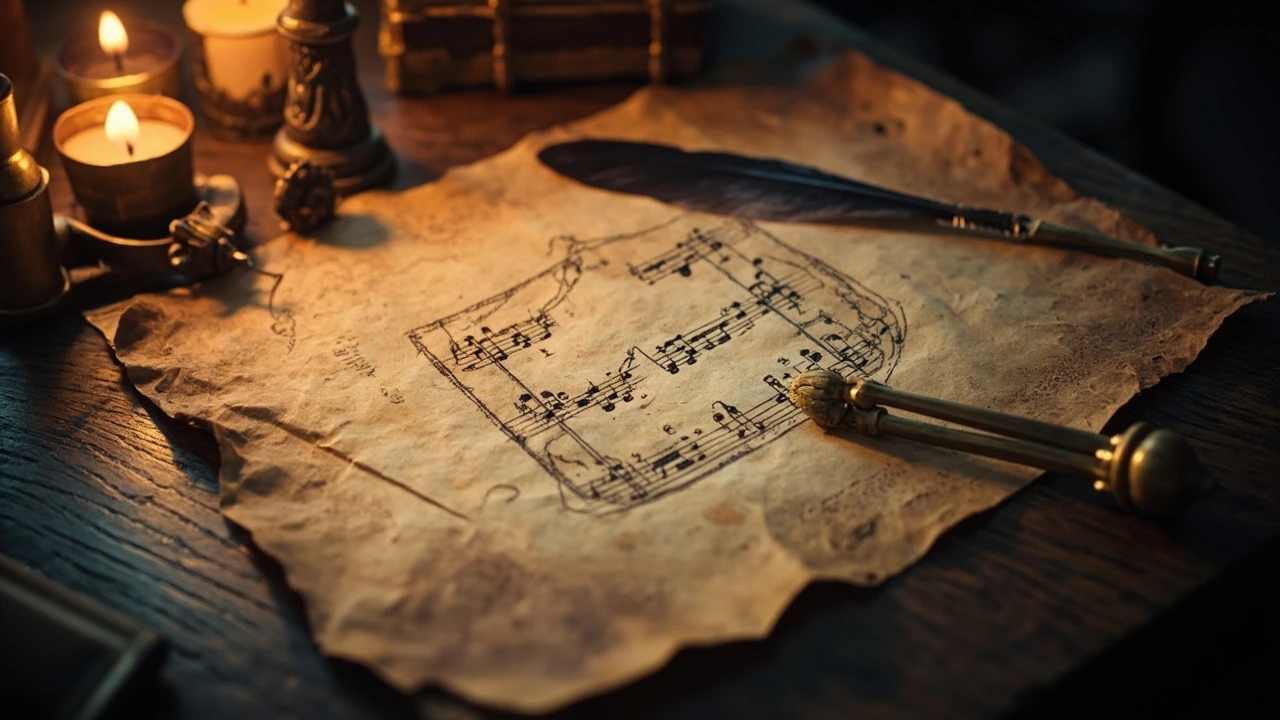
The parchment does not display traditional Western staff notation. Instead, each note is shown as a symbol inside a small circle, and the circles are arranged in either a ring or a vertical column, depending on the specific map. The arrangement is decorative, but the order of the symbols along the parchment is the only information that matters. Reading left to right, top to bottom, or in a clockwise direction is a common source of mistakes, so the player should pause for a moment to confirm the intended direction before activating the first disk.
The symbols themselves reuse the same icon family across every musical map. Players will recognize a small filled circle for one note, a hollow circle for another, a triangle for a third, and so on. The full symbol set is small enough that a player can memorize it after solving two or three maps. The key habit is to anchor the parchment visually: rotate the camera so the parchment is flat and well lit, then count the symbols in order before touching any disk. This single step prevents most failed attempts.
Where the musical maps are found
Musical maps in Hogwarts Legacy are scattered across the open world rather than concentrated in a single region. The most common placement is near a small structure, such as a ruined tower, a covered pavilion, a lake house, or a stone gazebo. The map parchment usually rests on a flat surface close to the entry point, and the bronze instrument frame is positioned within a few steps so the player never has to backtrack. The puzzle is set in the open air, not inside a dungeon, which means the player can solve it during normal exploration without a story gate.
The actual distribution of maps leans toward the southern half of the world map, but the developer placed at least one in each major biome to encourage travel. The maps are not flagged on the main region map by default; instead, the player often notices them through ambient audio. A soft, faint tune plays within a short radius of the parchment, which functions as both a signal that a map is nearby and a thematic cue for the activity. Players who prefer stealth and quiet exploration tend to hear the tune before they see the map.
Step-by-step process to solve a musical map
- Approach the parchment and read the order of note symbols from start to finish, confirming the direction of the sequence.
- Walk to the bronze instrument frame a few steps away and stand close enough for the basic cast to register on each disk.
- Identify the first symbol on the map and locate the matching disk on the frame.
- Cast the basic spell on the first disk, then move to the second disk that matches the second symbol, and continue in order.
- If the sequence is correct, the game confirms the melody and triggers the reward. If not, listen for the dissonant sting and start the sequence again from the first disk.
This pattern repeats for every musical map, and the difficulty never escalates beyond longer note sequences. The first maps use three-note melodies, and the later maps expand to five notes. There is no timing window in the current implementation, which means the player can pause between notes as long as needed. The absence of timing pressure is a deliberate design choice that keeps the activity accessible to players who do not read music.
Common mistakes when solving musical maps
The first mistake players make is reading the symbols in the wrong order. The decorative layout can be misleading, and a player who treats a circular arrangement as a ring rather than a linear sequence will almost always fail the first attempt. The fix is simple: pick the most obviously starting symbol, count the rest in order, and confirm the last symbol before activating a disk.
The second common mistake is interacting with the wrong type of object. Some musical map locations have a regular collection chest or a Merlin Trial pedestal near the bronze frame, and the player occasionally casts a spell on the wrong surface. The basic cast is generous and will usually bounce off unintended objects, but a focused cast at the wrong target can briefly interrupt the puzzle. Taking a moment to walk directly up to the bronze frame prevents this.
The third mistake is leaving the immediate area while the sequence is in progress. The musical map does not have a strict range check, but the ambient audio that confirms each correct note is faint, and moving away can cause the player to miss the feedback cue that signals an error. Staying within a few steps of the frame for the entire sequence keeps the audio cues clear.
Rewards and why the musical map is worth solving
Each musical map in Hogwarts Legacy grants a cosmetic or gear reward when solved. The most common reward is a unique wand handle, robe variant, or a small but useful trinket. Wand handles in particular are tied to specific collectible categories, and the musical map set is one of the cleanest sources of handle variety. The rewards are not random; every player who solves a given map receives the same item, which makes the maps safe to skip for a player who does not care about cosmetics and reliable to chase for a completionist.
Beyond the direct reward, solving a musical map contributes to a small completion counter that appears under the relevant field guide page. The counter is not tied to a Trophy or Achievement in the strictest sense, but it is one of the activities the game tracks when measuring the percentage of a region explored. For a player who wants the highest possible exploration total without grinding combat or fast travel, the musical map set offers a quiet, low-risk path to a higher number.
How the musical map fits into the broader collectible design
The musical map is one piece of a larger collectible design in Hogwarts Legacy that includes Demiguise statues, Daedalian keys, landing platforms, Merlin Trials, and a few smaller secret sets. Each set teaches a different skill. Demiguise statues teach stealth access to locked houses. Daedalian keys teach glider-based platforming. Landing platforms teach broom handling. The musical map set teaches basic cast timing and pattern reading. The variety is part of the game’s design language: no two collectible sets ask the player to use exactly the same skill in the same way.
From a production standpoint, the musical map set is also a small but useful example of how a single input system, the basic cast, can be reused for very different challenges. The same spell that opens a locked door in a dungeon is the spell that activates a bronze disk in a quiet pavilion. That kind of reuse reduces the cognitive load on the player, which in turn keeps the game from feeling bloated. The musical map is one of the cleanest examples of that reuse because the inputs are simple and the feedback is immediate.
How Hogwarts Legacy handles music as a theme
The musical map is also a small window into how the Hogwarts Legacy team treats music as a world-building tool. The score by J Scott Rakozy and Alexander Horowitz leans on melodic motifs tied to specific locations, and the in-world music puzzles mirror that approach. The notes on a musical map are not arbitrary symbols; they are short motifs that fit the area where the map is found. A musical map in a quiet lakeside ruin tends to use slower, lower notes, while a map in a more exposed location uses higher, brighter notes. The pattern is subtle, but players who solve several maps in a row start to hear the connection between the parchment and the surroundings.
This kind of musical world-building is also a useful example for anyone studying open-world design. A game can reinforce a location’s mood by aligning its collectible systems with its score, even when the collectible itself is mechanical. The musical map shows that a small, repeatable activity can carry a thematic weight that lasts for the entire playthrough, especially for a player who solves the maps in a different order than the developers intended.
Tips for completing every musical map efficiently
- Travel by broom or fast travel to a discovered Floo Flame close to the target location, then move on foot so the ambient music cue is easier to hear.
- Approach the parchment from a low angle so the symbols on the parchment are clearly visible against the sky or a dark background.
- Use the camera’s photo mode if the symbols are hard to read, then zoom in on the parchment before walking to the instrument frame.
- Confirm the order of the symbols out loud, or count under your breath, so the sequence is committed to short-term memory before the first cast.
- Stand close to the bronze frame and face the parchment so the symbols remain visible while the cast is prepared.
These habits are not required, but they cut the average solve time for a new musical map from a few minutes to under a minute. The puzzle itself is short once the input language is learned, so the only real skill to practice is the reading step.
What to do if a musical map will not complete
If the sequence keeps failing, the most likely cause is a misread symbol or a misordered sequence. Walk away from the frame, return to the parchment, and recount the symbols. If the sequence still fails after a second read, save the game, reload the most recent save, and attempt the puzzle again. The musical map is not a glitch-prone feature in the current build, and a reload usually clears any state inconsistency that a partial attempt can introduce.
If the map still refuses to complete after a reload, the cause is usually a missed update. The Hogwarts Legacy team has released patches that adjusted various collectible behaviors, and a player who has not updated to the latest version may run into a small number of issues. The safe first step in that case is to confirm the game is on the latest patch through the platform launcher, then re-attempt the map. If the issue persists, reporting the exact location, platform, and patch version to the publisher’s support channel is the appropriate next move rather than restarting the entire playthrough.
Musical map versus Merlin Trials: how the puzzles differ
The musical map and the Merlin Trial are both small open-world puzzles, but they use very different inputs. A Merlin Trial asks the player to perform a small physical action in the environment, such as lighting a set of braziers, rolling a ball through a maze, or animating a group of statues. The action is free-form and the player can solve the trial in any order. The musical map is the opposite: the action is constrained to a single instrument frame, and the order is fixed by the parchment. Both puzzles are short, but the mental model is different.
| Attribute | Musical map | Merlin Trial |
|---|---|---|
| Primary input | Basic cast on bronze disks | Free-form environment interaction |
| Order of steps | Fixed by the parchment | Player decides |
| Typical sequence length | 3 to 5 notes | 2 to 4 environment steps |
| Time pressure | None | None in most trials |
| Reward type | Cosmetic gear, often a wand handle | Stat upgrade or cosmetic |
| Completion contribution | Field guide page counter | Field guide page counter |
The two systems complement each other. A player who enjoys the precise reading of a musical map will likely also enjoy the timed landing platform challenges, while a player who enjoys the free-form Merlin Trials will likely enjoy the Demiguise statue search. The Hogwarts Legacy team spread the input types across the collectible set so that no single style dominates the open-world loop.
Where the musical map fits in a typical playthrough
The musical map is a mid-game collectible in practice. The first map tends to be reachable within the first few hours of play, but the full set is most efficient to collect once the player has unlocked the broom, the basic cast upgrade, and at least one fast travel point in each region. A player who tries to chase every musical map on foot in the first hour will spend more time traveling than solving. A player who returns to the maps after unlocking the broom and a few Floo Flames will clear the set in a single focused session.
For a player who wants to combine the musical map set with other collectibles, the best pattern is to plan a broom route that hits one musical map, one Merlin Trial, and one Daedalian key in the same loop. The three activities tend to cluster in similar locations, so a careful route can clear several collectible categories in a single pass. The route does not need to be optimized for a speedrun; a casual loop that returns to a Floo Flame between regions is fast enough for completion without burnout.
How the musical map is described in the game’s official materials
The Hogwarts Legacy team has described the musical map set in the broader context of the open-world exploration loop, alongside the other field guide activities. The game’s official materials position the musical map as a quiet, contemplative activity that rewards careful observation rather than fast reflexes. The set is also referenced in community updates as one of the activities that contributed to the game’s strong exploration pacing, especially in the southern regions where the maps are densest.
That pacing claim is consistent with the player experience. A musical map does not interrupt the main story, does not require a specific build, and does not punish a failed attempt. The activity fits the moment between a combat encounter and a story beat, which is exactly the kind of slot a well-paced open world needs. The musical map is a small piece of the larger Hogwarts Legacy design, but it is a clean example of how a side activity can support the main campaign without competing with it.
Comparing the musical map to similar collectible types in other open-world games
The musical map is a useful comparison point for collectible design across the open-world genre. A game like The Legend of Zelda: Breath of the Wild uses shrine quests that combine a small environmental puzzle with a short combat or traversal challenge. A game like Elden Ring uses field bosses that combine a long approach with a single, high-stakes fight. The musical map is closer to a shrine quest in spirit: short, repeatable, low stakes, and tied to a specific input type. The key difference is that the musical map reuses the same input every time, while a shrine quest tends to vary the input type across the set.
| Game | Comparable collectible | Input type | Failure cost | Reward focus |
|---|---|---|---|---|
| Hogwarts Legacy | Musical map | Basic cast, fixed sequence | Time only | Cosmetic gear |
| Breath of the Wild | Shrine quest | Environmental puzzle | Time only | Upgrade material |
| Elden Ring | Field boss | Combat encounter | Rune loss on death | Remembrance item |
| Ghost of Tsushima | Hotspring | Short traversal | None | Minor stat boost |
The comparison makes a useful point for anyone studying collectible design. The musical map occupies a low-stakes, high-frequency slot in the Hogwarts Legacy open-world loop, and that slot is a deliberate choice. A game that fills its open world only with high-stakes challenges burns players out, while a game that fills it only with cosmetic collectibles feels shallow. The musical map sits between the two extremes, which is exactly the kind of balance a long open-world game needs.
What the musical map teaches about input reuse in Hogwarts Legacy
Input reuse is one of the quieter design lessons the musical map offers. Hogwarts Legacy leans heavily on the basic cast as a multi-purpose tool, and the musical map set is the cleanest demonstration of that choice. The same spell opens doors, lights braziers, triggers statues, and plays bronze disks. A player who learns the basic cast once can apply it to every one of those systems, which keeps the tutorial load low and the world consistent.
Input reuse is also a useful pattern for any developer building a large open world. A small set of inputs that can be combined in different ways produces more variety than a large set of single-purpose inputs, especially when the inputs are visually distinct. The basic cast in Hogwarts Legacy is visually distinct, audio-distinct, and animation-distinct from other spells, which makes it easy to identify even when the camera is far from the player character. The musical map is a good example of how that input system can carry an entire collectible set without feeling repetitive.
Limitations of the musical map design
The musical map is not perfect. The lack of a timing window means the puzzle can feel slow for a player who is used to rhythm-based challenges, and the fixed sequence length means the difficulty does not scale beyond the final maps. A player who solves the first musical map in under a minute will not find a meaningful jump in difficulty later, and the set can feel predictable once the input language is fully internalized. Those limitations are not flaws in the strict sense; they are the natural cost of keeping the puzzle accessible to a wide audience.
A more experienced player who enjoys a stronger challenge may also notice that the musical map rewards are cosmetic, which reduces the incentive to chase the full set. The game balances this by spreading the maps across the open world, so a player who is already exploring will encounter the maps without much extra effort. The design is a reasonable trade-off for the target audience, but it is worth naming the trade-off rather than pretending the puzzle offers more depth than it does.
How the musical map compares to reading real sheet music
The musical map does not teach real music reading, and it is worth being clear about that. The symbols on the parchment are a simplified icon set, not a faithful representation of treble clef notation. A player who wants to learn real sheet music will need a separate resource; the musical map is a game mechanic that borrows the visual language of music without attempting to teach it. That separation is healthy for both the game and the player, because it keeps the puzzle focused on the in-world activity rather than on a real skill that the game cannot actually teach.
That said, the musical map can serve as a soft introduction. A player who enjoys the puzzle and wants to understand the real notation behind it can use the musical map as a starting point and then move to a beginner music resource. The game does not advertise this path, but it is a useful side effect of a design that uses musical imagery in a respectful way. The team kept the symbols abstract on purpose, which is a small but real example of good design restraint.
Frequently asked questions
What is the musical map Hogwarts Legacy puzzle?
The musical map is a side activity in Hogwarts Legacy that combines a small parchment printed with note symbols and a bronze instrument frame. The player reads the order of symbols on the parchment and plays the matching sequence on the frame using the basic cast. Solving the map grants a cosmetic reward and contributes to the field guide page counter for the region.
How many musical maps are there in Hogwarts Legacy?
The exact count of musical maps is small enough that a careful player can clear the set in a single focused session, but the maps are spread across the open world so a player has to travel between them. The set is not gated by main story progress, although a player who has unlocked the broom and the relevant Floo Flames will collect them more efficiently.
Do musical maps count toward 100 percent completion in Hogwarts Legacy?
Yes, musical maps contribute to the field guide page counters that the game uses to track exploration completion. Solving every map increases the percentage of each region that is marked as explored, and the set is one of the cleaner completion paths for a player who wants a higher number without grinding combat encounters.
What reward do you get from a musical map?
The reward is typically a cosmetic item, most often a unique wand handle or a robe variant. Every player who solves a given map receives the same item, which makes the maps safe to skip for a player who does not care about cosmetics and reliable to chase for a completionist who does.
Can you solve a musical map after the main story?
Yes. The musical maps are available throughout the open world regardless of main story progress, and the player can return to any map after finishing the campaign. The puzzles are not removed by story events, and the rewards remain the same in the post-game state as they were during the main playthrough.
Do you need the broom to reach every musical map?
No, but the broom makes the set much easier to collect. Some musical maps are placed in locations that are quicker to reach on a broom, and a player who plans a broom route can clear several maps in a single loop. A player who is still early in the game and does not yet have the broom can still reach the first few maps on foot.
Is there a timer on the musical map sequence?
No. The musical map does not have a timing window, which means the player can pause between notes as long as needed. The lack of a timer is a deliberate design choice that keeps the puzzle low stakes and accessible to players who do not read music. The only feedback is the chime for a correct note and the dissonant sting for an incorrect one.
What should I do if a musical map will not complete?
The most common cause is a misread symbol or a misordered sequence. Walk away from the instrument frame, return to the parchment, and recount the symbols from start to finish. If the sequence still fails, save and reload the most recent save, then re-attempt the puzzle. If the issue persists, confirm the game is on the latest patch and report the location and platform to the publisher’s support channel.
Are musical maps related to the main story of Hogwarts Legacy?
The musical maps are not tied to the main story in a mechanical sense, but they support the same world-building. The maps are placed in locations that fit the broader Hogwarts Legacy atmosphere, and solving the set is a way to experience parts of the world that the main story does not visit directly. The activity is a small but useful complement to the campaign rather than a separate mode.
Do I need to know music to enjoy the musical map puzzle?
No. The puzzle uses a simplified symbol set that does not require any prior knowledge of music. A player who can match a symbol on a parchment to a disk on a frame can solve the puzzle. The musical map is designed to be accessible to a wide range of players, and the absence of a timing window keeps the activity low pressure.
For more on how Hogwarts Legacy structures its open-world collectibles and how those systems compare to other major releases, the legendary animals in Red Dead Redemption 2 guide offers a useful contrast in pacing, and the Unity vs Unreal engine comparison covers the broader production decisions behind large open-world projects. The musical map itself is also a small but real example of how a single in-game input can carry an entire collectible set without becoming repetitive, which is the same design pattern Hogwarts Legacy applies to its Merlin Trials and Demiguise statue searches.
Leave a Reply